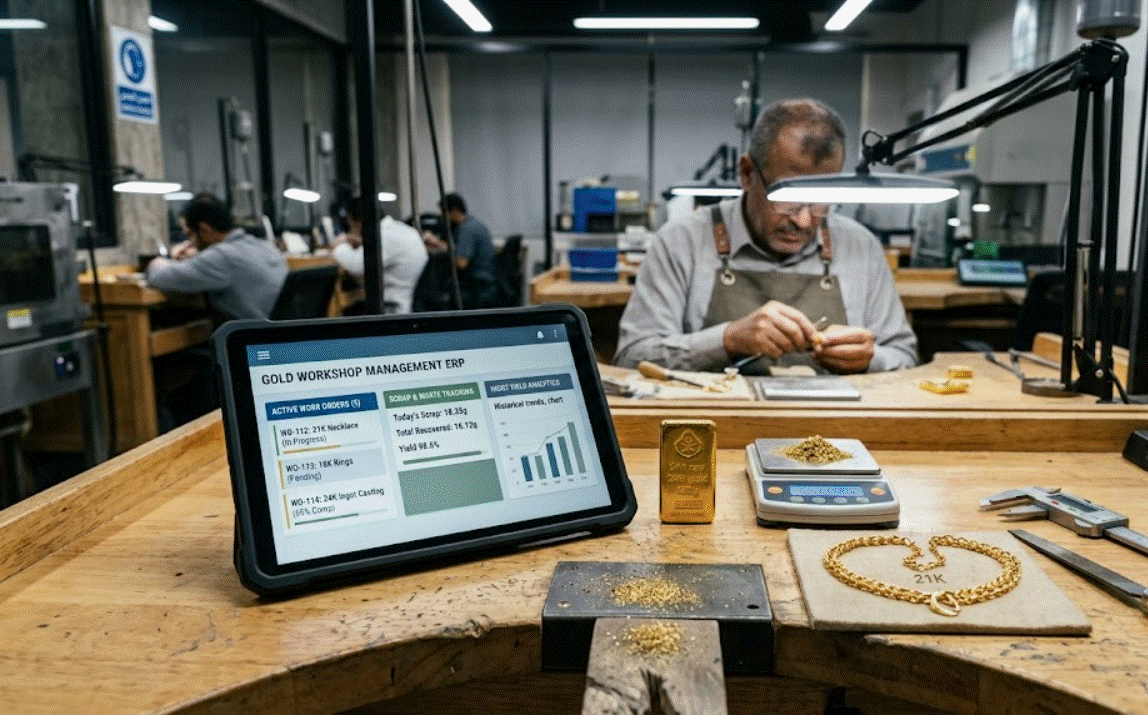
The journey of transforming a raw, unrefined ingot into a breathtaking piece of fine jewelry is an ancient and deeply respected art form. However, in the modern commercial landscape, this artistic process is also a high-stakes financial operation. Because precious metals are valued by the fraction of a gram, the physical reality of manufacturing means that with every cut, file, and polish, a portion of your liquid capital is turned into airborne dust.
For decades, many artisans accepted a high margin of material loss as simply the cost of doing business. Today, with global commodity prices soaring, unchecked shrinkage will quietly destroy your profit margins. Transforming your operation requires a shift from traditional craftsmanship to highly controlled Gold workshop management. By implementing a specialized Enterprise Resource Planning (ERP) system, you can track every milligram of metal, monitor artisan efficiency, and completely eradicate unexplained losses.
In this guide, we will explore the critical touchpoints where gold vanishes, how to enforce rigorous digital tracking, and why mastering your manufacturing data is the ultimate key to operational profitability.
1. The Anatomy of Manufacturing Loss
To control waste, you must first understand exactly where the metal goes. The creation of jewelry is a reductive process; you start with a heavy block of metal and carve away the excess.
The Melting and Casting Phase
The journey begins at the melting station. Pure 24-karat gold is too soft for everyday wear, so it is often alloyed with other metals (like copper or silver) to create a more durable Gold karat, such as 18k or 21k. When these metals are subjected to extreme heat inside the Crucible, a minute percentage of the material is lost to vaporization and oxidation. Furthermore, residue inevitably clings to the interior walls of the casting equipment. Without proper tracking, these microscopic losses accumulate into massive financial deficits over the fiscal year.
Filing, Sanding, and Polishing
Once the rough piece is cast, the artisan takes over. Filing and sanding remove the rough edges, generating heavy metal shavings that fall to the workbench. The final stage—polishing—is the most dangerous for shrinkage. High-speed buffing wheels vaporize the outer layer of the metal to create a mirror finish, sending microscopic gold dust into the air and the ventilation system. Proper Gold workshop management requires capturing this dust, but more importantly, it requires mathematically tracking the expected loss against the recovered material.
2. Digitizing the Floor: Work Orders and Accountability
The biggest vulnerability in traditional workshops is the reliance on paper ledgers. When a workshop manager hands 100 grams of gold to a goldsmith and writes it down in a notebook, accountability instantly drops. From raw bullion intake to the finished piece, an erp gold platform tracks metal loss at every manufacturing stage instead of relying on end-of-month estimates. Talk to Daysum about connecting your workshop floor to the system.
Enforcing Strict Work Orders
By deploying an advanced jewelry ERP software, every action on the factory floor is digitized. The process begins by generating digital Work orders. These orders act as a strict contract between the vault and the artisan. The system records the exact weight, karat, and specific design requirements of the metal issued. The artisan is now entirely responsible for that specific weight.
Tracking Artisan Efficiency
A modern ERP does more than track metal; it tracks the human element. By utilizing barcode scanners at each workstation, artisans clock in and out of specific tasks. This provides management with real-time data on Workmanship. You can instantly see which artisans are the most efficient, which ones consistently produce defects, and which ones are taking too long on specific designs, allowing you to optimize your labor costs alongside your material costs.
Traditional vs. ERP-Managed Workshops
| Operational Area | Traditional Workshop | ERP-Managed Workshop |
|---|---|---|
| Material Issuance | Handwritten notes; highly susceptible to human error. | Digitally linked Work orders tracked by the gram. |
| Loss Tracking | Calculated at the end of the month via mass weigh-ins. | Tracked per individual piece and per individual artisan. |
| Accountability | Low; difficult to pinpoint who is losing excess metal. | High; real-time data highlights inefficient workstations. |
| Routing Visibility | Management must physically walk the floor to check status. | Live dashboard showing exactly where each piece is in production. |
3. Mastering Scrap Calculation and Allowable Loss
It is physically impossible to manufacture jewelry without generating scrap. Therefore, the goal of modern Gold manufacturing management is not zero loss, but perfectly controlled, allowable loss.
Every specific jewelry design should have a predefined allowable shrinkage percentage. A simple, smooth wedding band might only lose 1% of its weight during manufacturing, while an intricate, heavily filed diamond setting might lose 3%.
When an artisan returns the finished piece along with the collected scrap (filings and clippings), the system performs an instant Scrap calculation.
- The Math: (Weight Issued) – (Weight of Finished Piece + Weight of Returned Scrap) = Actual Shrinkage.
- The Guardrail: If the actual shrinkage falls within the allowed 3%, the system accepts it. If the artisan returns the piece with a 5% loss, the software immediately flags the transaction, preventing the work order from closing and triggering an immediate management audit.
This precise, unyielding calculation completely eliminates the temptation for internal theft and forces artisans to maintain the highest levels of material discipline.
4. Protecting Your Core Gold Inventory
The workshop floor does not operate in a vacuum; it is deeply connected to your company’s central financial health. Every gram lost in the workshop is a direct deduction from your corporate balance sheet.
By utilizing comprehensive gold accounting software, your manufacturing floor and your central vault are perfectly synchronized. When raw metal is issued to the workshop, it is transferred out of the main vault and into a “Work in Progress” (WIP) ledger. When the finished jewelry is returned, the pure Gold inventory is credited, the allowed shrinkage is written off as an exact manufacturing expense, and the craftsmanship labor cost is capitalized into the final value of the item.
Gold Waste Touchpoints and ERP Solutions
| Manufacturing Stage | Primary Source of Waste | The ERP Solution |
|---|---|---|
| Alloying & Melting | Vaporization and Crucible residue. | Tracks exact pre-melt and post-melt weights to enforce strict melting allowances. |
| Filing & Assembly | Heavy metal shavings falling to the floor. | Digitizes expected scrap returns; flags artisans who return less scrap than mathematically expected. |
| Polishing | Airborne microscopic dust. | Reconciles the weight of refined dust (from filters) against the cumulative allowable loss for the quarter. |
| Final Assembly | Stone breakages or misplaced findings. | Detailed Work orders track the exact number of diamonds and clasps issued vs. consumed. |
Conclusion: Engineering Profitability
The romanticized image of a dusty, chaotic goldsmith’s bench is fundamentally incompatible with the harsh financial realities of the modern precious metals market. Maximizing your profitability requires treating your workshop not just as an artist’s studio, but as a precision-engineered manufacturing plant.
By embracing digital Gold manufacturing management, you replace guesswork with undeniable data. You enforce strict Work orders, monitor the quality of Workmanship, and execute mathematically flawless Scrap calculation on every single piece. Integrating this data with your central Gold inventory ensures that your executive team has total visibility over your liquid assets. Equip your enterprise with a specialized ERP system today, and turn your workshop from a center of material waste into an unshakeable engine of profit.
Frequently Asked Questions (FAQs)
A specialized jewelry ERP system utilizes dynamic Bills of Materials (BOM). When you configure a product, you define its specific Gold karat and the required manufacturing routing. The software automatically applies the correct allowable loss percentage based on the specific metallurgical properties of that karat and the complexity of the design, ensuring the Scrap calculation is always contextually accurate.
Yes. When you send your vacuum bags, water settling tank sludge, and air filters to a professional refinery, the ERP allows you to log this as "Unrefined Scrap Transfer." Once the refinery returns the pure fine gold, the system logs the recovered weight back into your main Gold inventory and reconciles the value against the accumulated manufacturing shrinkage written off during that specific operational period.
The software includes a dedicated "Rework" or "Scrap" protocol. If an item is damaged during filing or stone setting, the artisan reports it to the manager. The manager updates the digital work order, categorizing the item as defective. The damaged piece is returned to the vault to be melted down, and the system accurately logs the wasted labor time without incorrectly penalizing the artisan's material shrinkage rate.
Initially, there is a minor learning curve as artisans adapt to scanning barcodes or weighing items on digital scales connected to the system. However, in the long term, production speed increases dramatically. Because the ERP provides clear digital instructions, eliminates time spent searching for lost paper ledgers, and streamlines the issuance of raw materials, your artisans spend less time managing administration and more time actually crafting jewelry.