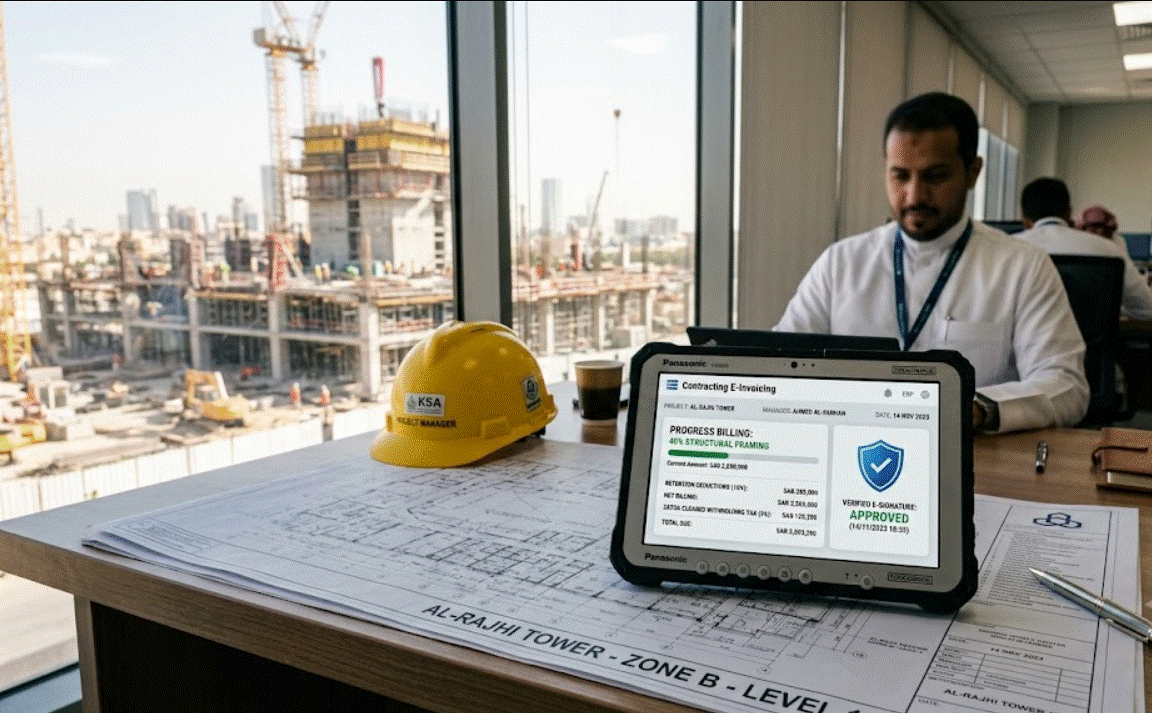
The construction and contracting sector operates on an entirely different financial frequency than standard retail or manufacturing. Projects do not wrap up in a matter of minutes or days; they span months, years, and multiple fiscal quarters. Because of these extended timelines, cash flow is the absolute lifeblood of a contracting firm. A delayed payment from a project owner can stall procurement, halt subcontractor labor, and completely derail a project’s critical path.
As we navigate through 2026, the financial landscape has fundamentally shifted. Regional governments and the national Tax authority have mandated strict digital compliance for all corporate entities. For contracting firms, transitioning to an automated E-invoicing system is no longer just about staying legally compliant; it is about protecting your cash flow. Relying on Excel spreadsheets and Word documents to manage multi-million-dollar construction milestones is a massive operational risk.
In this comprehensive guide, we will explore why generic billing systems fail in the construction industry. We will demonstrate how a specialized Contracting e-invoice effortlessly handles complex Progress billings, navigates the intricate web of Contracting taxes and deductions, and utilizes secure E-signature protocols to ensure your B2B invoices are cleared and paid without delay.
1. The Unique Complexity of Contracting Finance
In a standard B2B wholesale transaction, the financial exchange is linear: you deliver a batch of goods, you issue an invoice for the total amount, and the client pays you. The contracting sector shatters this linear model.
The Challenge of Percentage-of-Completion
Contractors do not invoice for a building once it is fully constructed; they bill incrementally based on the percentage of work completed over a specific period. These Progress billings are inherently complex. They require the project engineer to submit a technical completion certificate (often called an Interim Payment Certificate or IPC), which the finance team must then translate into a legally compliant tax invoice.
If your firm uses disconnected software, bridging the gap between the engineering site and the accounting office takes days. Manual data entry increases the risk of calculation errors, leading the project consultant or the client to reject the invoice. In construction, a rejected invoice means your cash flow is frozen for another 30 to 60 days.
2. Mastering Progress Billings Digitally
Deploying a specialized project management software integrated with your accounting ERP completely automates the IPC and invoicing workflow, ensuring your firm gets paid on time, every time.
Automated Milestone Invoicing
With an integrated E-invoicing system, the workflow is seamless. When the site engineer updates the project completion status (e.g., “Foundation Stage: 100% Complete, Structural Framing: 40% Complete”), the ERP instantly calculates the monetary value of that progress based on the original Bill of Quantities (BOQ).
The finance department simply reviews the system-generated draft and clicks a button to generate the Contracting e-invoice. The system automatically pulls the correct client details, references the master contract number, and formats the document perfectly. This transition from a manual, multi-day struggle to an instant, automated click drastically accelerates your accounts receivable cycle.
Traditional Billing vs. Automated Progress Billings
| Operational Metric | Manual Contracting Invoicing | Integrated E-Invoicing System |
|---|---|---|
| Data Synchronization | Finance and engineering teams use separate, disconnected spreadsheets. | Real-time link between site progress and the financial ledger. |
| Calculation Accuracy | High risk of mathematical errors leading to rejected IPCs. | Flawless, automated calculation based on the approved BOQ. |
| Invoice Generation Time | Takes 3 to 7 days of back-and-forth approval loops. | Takes minutes; generated instantly upon consultant approval. |
| Cash Flow Velocity | Slow; prone to long delays and client disputes. | Fast; accurate invoices expedite the client’s payment release. |
3. Navigating Contracting Taxes, Retainage, and Deductions
Generating the gross amount for a progress bill is only the first hurdle. The true nightmare of construction accounting lies in the deductions. A standard Contracting e-invoice is a complex mathematical document that must account for multiple withholdings before arriving at the final net payable amount.
Managing Retention and Advance Payments
Most construction contracts stipulate that the client will withhold a “Retention Amount” (usually 5% to 10%) from every progress bill to ensure the final quality of the work. Additionally, if the contractor received a mobilization advance payment at the start of the project, a percentage of that advance must be deducted from each subsequent invoice until it is fully recovered.
A generic invoicing tool cannot handle these simultaneous deductions accurately. An advanced accounting ERP software automatically calculates the retention, subtracts the advance payment recovery, and posts these amounts to the correct temporary liability and asset accounts in your general ledger.
Flawless Tax Compliance
Contracting taxes are heavily scrutinized by the government. The ERP ensures that Value Added Tax (VAT) is applied to the correct subtotal (which varies based on specific regional tax laws regarding retention money).
Furthermore, many jurisdictions require clients to deduct Withholding tax (WHT) at the source before paying the contractor. The e-invoicing system explicitly breaks down the gross amount, the VAT, the retention, and the Withholding tax, presenting a crystal-clear, legally compliant document to the Tax authority and the client.
Handling Deductions in a Contracting E-Invoice
| Deduction Type | Purpose in Contracting | How the ERP Automates It |
|---|---|---|
| Advance Payment Recovery | Repaying the initial mobilization funds provided by the client. | Automatically deducts the agreed percentage from the gross progress amount. |
| Retention (Retainage) | Held by the client as a quality guarantee until project handover. | Calculates the 5-10% holdback and routes it to a specific Retention Receivable account. |
| Value Added Tax (VAT) | Standard consumption tax mandated by the Tax authority. | Automatically applies the 14% or 15% rate to the legally taxable base amount. |
| Withholding Tax | Tax deducted at the source by the client on behalf of the government. | Calculates the specific Withholding tax rate and logs it as a tax credit asset. |
4. The E-Signature and B2B Pre-Clearance
In 2026, simply generating a PDF of your progress bill and emailing it to the project owner is no longer legally sufficient. To combat tax evasion and ensure absolute transparency in high-value B2B contracts, governments rely on sophisticated cryptographic clearance models.
Securing the Invoice
Before your Contracting e-invoice is legally recognized, it must be digitally sealed. An integrated ERP utilizes a certified E-signature (via a USB e-Seal token or a Cloud Hardware Security Module). This cryptographic signature proves unequivocally that the invoice originated from your firm and that the financial totals have not been tampered with.
Instant Tax Authority Clearance
Once the E-signature is applied, the software transmits the XML or JSON payload directly to the Tax authority portal via a secure API. The government servers validate the project codes, the tax calculations, and the signature, returning a Unique ID within milliseconds. Only then is the invoice legally dispatched to your client.
By utilizing seamless ZATCA E-invoicing integration (or the equivalent ETA integration in KSA), you ensure that your multi-million-pound progress bills are never rejected at customs or by corporate auditors, completely safeguarding your company’s financial lifeline.
Conclusion: Build Your Digital Foundation
A successful contracting firm is built on precise engineering, reliable labor, and unshakeable financial control. In a highly regulated environment, continuing to manage your project billing through manual, fragmented processes is the fastest way to cripple your cash flow and invite aggressive government tax audits.
By implementing a specialized E-invoicing ecosystem tailored for the construction sector, you eliminate the friction between the job site and the finance department. You gain the power to instantly generate accurate Progress billings, perfectly calculate complex Contracting taxes and Withholding tax, and secure your B2B transactions with a legally binding E-signature. Upgrade your financial infrastructure today, satisfy the Tax authority, and ensure your enterprise has the liquid capital required to build the future.
Frequently Asked Questions (FAQs)
Yes. Retention money is held in a specific "Retention Receivables" ledger within the ERP. When the project reaches practical completion and the final handover certificate is signed, the system automatically alerts the finance team to generate a final, separate Contracting e-invoice strictly for the release of the accumulated retention funds, ensuring this massive cash injection is never forgotten.
Absolutely. A robust construction ERP is designed for dynamic project environments. If the client approves a Variation Order that adds new materials or labor to the scope, the system instantly updates the master Bill of Quantities (BOQ). Subsequent Progress billings will automatically include the new line items, allowing you to invoice for the additional work legally and accurately.
If your finance team is distributed, relying on a single physical USB token plugged into an office computer is inefficient. Modern cloud ERPs integrate with Cloud HSMs (Hardware Security Modules) certified by the local Tax authority. This allows authorized finance personnel to apply the E-signature to invoices securely from any location via the cloud, without needing the physical USB token in their hands.
In contracting, disputes over completion percentages are common. Because B2B e-invoices operate on a strict clearance model, you cannot simply "delete" the invoice once the government has accepted it. If a client disputes the IPC, the ERP allows your finance team to easily generate a linked Electronic Credit Note to reverse the disputed amount, keeping your internal ledgers and the government's tax portal perfectly balanced.