In the high-stakes environment of luxury retail, business owners rightfully invest heavily in physical security. High-definition security cameras, armed guards, shatterproof glass, and biometric safes are standard requirements for any diamond boutique or bustling silver shop. However, these physical deterrents are primarily designed to stop external threats—the smash-and-grab robbers or the sophisticated nighttime burglars. The harsh reality of the jewelry industry is that a significant percentage of inventory shrinkage and profit loss does not walk out the front door in the hands of a stranger; it is siphoned away quietly from the inside.
Internal theft is the silent killer of retail profitability. It is rarely a dramatic heist. Instead, it is a slow, methodical bleed: a few missing grams of gold scrap here, an unrecorded cash discount there, or a “misplaced” silver chain. Because jewelry involves highly concentrated wealth—where a tiny, easily pocketed diamond can be worth thousands of dollars—the temptation for internal staff is exceptionally high. To truly Prevent Jewelry Theft, store owners must modernize their approach. You cannot manage modern threats with outdated logbooks and basic cash registers. You must deploy a comprehensive Enterprise Resource Planning (ERP) system to lock down your data, monitor every transaction, and create an environment where theft is instantly detectable and practically impossible to hide.
1. Closing Accounting Loopholes and Preventing Financial Fraud
Internal theft is not always the physical stealing of a diamond ring; very often, it takes the form of Financial fraud committed at the point of sale (POS) or in the back office. When a store relies on manual accounting or disjointed software, the loopholes are wide open for a dishonest employee to exploit.
The Vulnerability of the Cashier Station
The Cashier station is the front line of financial vulnerability. In a system without strict controls, a rogue cashier can easily manipulate transactions to steal cash without technically “stealing” inventory. A common tactic is the “phantom return” or the “voided sale.” A customer pays cash for a fast-moving silver necklace. The cashier hands the customer the item and a basic printed receipt, but later voids the transaction in the system, pocketing the cash. Because the inventory wasn’t properly linked to an immutable ledger, the missing necklace is eventually written off months later as a simple inventory counting error.
Automating and Locking the Financial Ledger
A modern jewelry management system closes these loopholes by creating unbreakable links between inventory movement and financial records. When an item is scanned and sold, the system automatically executes the corresponding accounting entries. To manipulate this, an employee would have to alter the core accounting ledger—a task that is heavily restricted.
By utilizing automated daily journal control, business owners ensure that once a transaction is closed, it cannot be quietly deleted. If a return or a void is genuinely necessary, the system requires a rigid, multi-step authorization process. It forces the return of the specific SKU back into the digital vault and logs the exact amount of cash that must be refunded. This level of synchronization eliminates the “gray areas” in your accounting that thieves use to hide their tracks.
2. Implementing Strict User Permissions (RBAC)
The foundational rule of digital security in a retail environment is the Principle of Least Privilege. Simply put, an employee should only have access to the information and system functions that are necessary to perform their specific job. Giving a weekend sales associate the same software access as the store manager is an invitation for disaster.
Customizing Access for Silver Shop Security vs. Diamond Boutiques
The level of required permission varies based on your inventory. Silver shop security often deals with high-volume, lower-ticket transactions. Here, you might grant cashiers the ability to process bulk sales quickly but strictly remove their ability to apply manual percentage discounts, preventing them from giving unauthorized “friends and family” deals.
In a high-end diamond boutique, the risks are different. You are dealing with unique, serialized stones where the cost basis is highly confidential. If a junior salesperson has access to your system’s wholesale landed costs, they could leak that sensitive pricing data to a competitor or use it to manipulate their own commission structures.
Role-Based Access Control (RBAC) in Action
A smart ERP system utilizes Role-Based Access Control (User permissions) to build a digital fortress around your data.
- The Sales Associate: Can view retail prices, check if a specific ring size is in stock, and process standard transactions. They cannot see wholesale costs, cannot delete past invoices, and cannot adjust inventory quantities.
- The Store Manager: Can authorize returns, apply pre-approved managerial discounts, and initiate stock transfers between branches. They cannot alter the global pricing matrix or delete the audit logs.
- The System Administrator (Owner): Has complete, unrestricted access to the secure digital infrastructure, overseeing all financial reporting, user access logs, and global inventory adjustments.
By actively enforcing these digital boundaries, you drastically reduce the opportunity for internal theft. An employee cannot steal what they cannot access, and they cannot manipulate a system that actively blocks their unauthorized inputs.
3. The Power of the Immutable Audit Trail
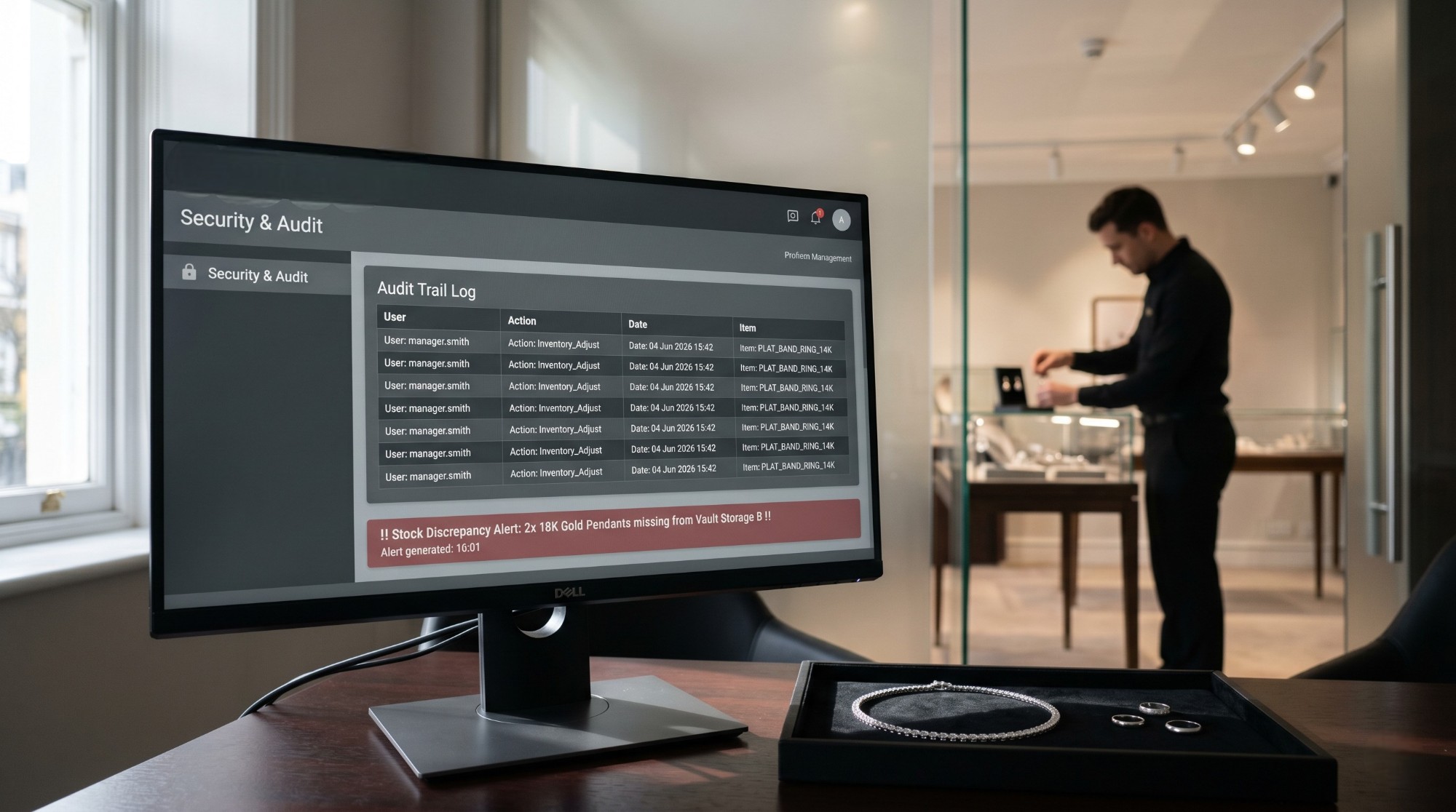
Deterrence is the most effective form of security. When employees know that every single keystroke, price check, and inventory adjustment is being watched and recorded permanently, the temptation to commit internal theft drops to near zero. This psychological and technical barrier is known as the Audit trail.
What is a Digital Audit Trail?
In legacy software systems, if a 2-carat diamond suddenly showed its weight as 1.5 carats in the database, the manager would have no way of knowing how or when that data changed. A modern jewelry ERP records the digital “fingerprint” of every user.
An immutable Audit trail acts as a silent, unblinking security camera for your database. It records the exact time, date, and user ID for every action taken in the software. If an employee logs in at 9:00 PM after the store is closed and attempts to adjust the quantity of 18K gold chains from five down to four to cover up a physical theft, the system logs the event.
Investigating Anomalies with Precision
When a discrepancy is discovered, the audit trail turns a generalized suspicion into hard evidence. You don’t have to guess which Cashier handled a problematic transaction. You simply pull the report. The audit trail will show you exactly who rang up the sale, who authorized the suspicious 30% discount, and which terminal was used.
This level of granular tracking is also essential for protecting honest employees. If a cash drawer is short, the audit trail can quickly prove that a specific cashier was logged out during the time the error occurred, directing the investigation to the correct party and maintaining a healthy, trusting workplace environment for your top performers.
4. Blind Stock Counts and Inventory Reconciliation
The most vulnerable time for a jewelry store is during the physical inventory audit. This is when the digital records are compared to the physical realities in the display cases and vaults. If you rely on traditional inventory counting methods, you are unintentionally providing dishonest employees with a roadmap to hide a Stock shortage.
The Danger of “Expected” Inventory Counts
In a standard inventory count, management typically prints out a list of all the items that should be in the store and hands it to the staff to verify. This is a massive security flaw. If a staff member has stolen a diamond bracelet, and they see that the printed list expects there to be three bracelets, they will simply write “3” on the clipboard to avoid raising any red flags. The discrepancy will remain hidden until a customer actually tries to buy the missing item.
Executing a Blind Diamond Audit
To truly Prevent Jewelry Theft, your ERP system must support “Blind Audits.” In a blind count, the staff is given a digital scanner linked to your specialized gold and jewelry management modules, but the screen does not tell them how many items are expected. They must physically scan every single barcode or RFID tag in the display case.
If there are supposed to be three diamond bracelets, but the staff member only scans two, the ERP system instantly flags a variance in the back-office dashboard. Because the staff member didn’t know what the target number was, they could not fudge the data to hide the missing item.
Immediate Reconciliation and Accountability
A smart jewelry management system makes inventory counts so fast and efficient that they can be conducted daily or weekly, rather than annually. By conducting a rapid, blind Diamond audit of your highest-value display cases every single morning and evening, you narrow the window of a potential theft to a specific shift. If a 1-carat loose diamond is there at 9:00 AM but missing during the 6:00 PM blind count, management immediately knows exactly which employees were on the floor during that narrow timeframe. This rapid reconciliation is the ultimate tool for recovering stolen assets before they leave the premises. Diamond pieces carry enough value per item that even a single unrecorded movement between the safe and the showroom can be a significant loss. Request a demo of Daysum’s audit-trail feature for high-value diamond stock.
Conclusion
Physical vaults and security cameras will always be necessary, but they only protect the perimeter of your business. The true heart of your jewelry operation—your inventory data, your pricing structures, and your daily cash flow—requires a sophisticated digital defense. By utilizing a modern ERP system to close accounting loopholes, enforce strict User permissions, maintain an unalterable Audit trail, and conduct frequent blind stock counts, you eliminate the shadows where internal theft thrives. Protecting your business is not just about catching thieves; it is about creating an environment of absolute transparency and accountability, ensuring that your hard-earned profits remain securely in your business where they belong. For modern jewelers looking to increase profitability, we highly recommend reading about Migrate Jewelry Data To New ERP.
FAQ
A: In a regular count, employees know how many items they are looking for, making it easy to lie to cover up a missing item. In a blind count, the system hides the expected quantity. Employees must scan exactly what is physically there, making it impossible to hide a Stock shortage.
A: No. In a properly configured cloud ERP system, the Audit trail is immutable. Even users with "Manager" or "Admin" privileges cannot delete or alter the system's historical logs. Only the software provider or the highest-level owner account controls data retention policies.
A: A common form of internal Financial fraud involves cashiers giving unauthorized "friends and family" discounts to accomplices, or ringing up an item at a discount, charging the customer full price, and pocketing the difference. Strict User permissions require manager approval for any price alteration.
A: If you utilize RFID scanning integrated with your ERP, you can conduct a full-store inventory count in minutes. This allows high-risk stores to audit their inventory multiple times a day, instantly identifying a missing item the moment a shift changes.