The jewelry industry is steeped in tradition, yet the operational mechanics driving top-tier retail brands have undergone a massive technological transformation. The days of relying on physical logbooks and isolated, localized computer networks are rapidly ending. Today, the debate over how to manage retail operations centers on one critical technological divide: Cloud vs. On-Premise architecture. For a modern jewelry business, selecting the right digital infrastructure is no longer just a technical necessity; it is a foundational business strategy that dictates how you manage high-value assets, secure customer information, and scale your operations across multiple geographical locations.
At the heart of this transition is Cloud Jewelry Software, a centralized approach to retail management that replaces bulky, expensive hardware with agile, internet-hosted solutions. Unlike traditional on-premise systems that require substantial upfront investments in physical servers and dedicated IT rooms within your store, cloud solutions operate seamlessly over secure internet connections. By storing your data in enterprise-grade data centers rather than in a back-office closet, you unlock unprecedented levels of mobility, security, and financial efficiency. This comprehensive guide will dissect the complexities of retail infrastructure, demonstrating why cloud-based systems are outperforming localized setups and transforming the ROI of the gold and diamond sectors.
1. The Hidden IT Costs of On-Premise Systems
When jewelry store owners evaluate new software, they often compare the initial price tags. An on-premise system might appear appealing because it is typically marketed as a one-time licensing fee. However, this “one-time” cost is a financial illusion. The true expense of localized software lies in the heavy, hidden burden of maintaining the physical infrastructure required to keep it running.
The Capital Expenditure (CAPEX) Trap
Deploying an on-premise system requires a massive initial Capital Expenditure (CAPEX). You must purchase powerful physical servers, commercial-grade cooling systems to prevent those servers from overheating, and specialized networking equipment. Because technology ages rapidly, these expensive servers have a limited lifespan. Within four to five years, your hardware will become obsolete, forcing you to undergo another massive round of purchasing just to maintain basic operational speeds.
In addition to the hardware, you are responsible for power consumption and the physical space the equipment occupies. In high-rent retail districts, dedicating a secure, climate-controlled back room to house blinking servers is a terrible use of expensive square footage that could otherwise be utilized for inventory vaults or VIP consultation rooms.
Managing Retail IT Staffing and Maintenance
The most expensive hidden cost of an on-premise system is human capital. When you own the servers, you own the problems. You must employ a dedicated Retail IT team or rely on expensive external contractors to monitor the system’s health, troubleshoot network crashes, and manually execute database backups. If a server goes down on a busy Saturday afternoon, your in-store IT team must scramble to fix the hardware while your sales floor is paralyzed.
Conversely, Cloud Jewelry Software operates on an Operational Expenditure (OPEX) model. You pay a predictable, transparent subscription fee. All Server costs, maintenance, hardware upgrades, and infrastructure management are handled entirely by the software provider. Furthermore, cloud systems provide seamless Auto updates. Instead of forcing your IT team to install new versions of the software manually after hours, the cloud system updates itself automatically overnight, ensuring that your store is always running on the latest, most efficient, and most secure version of the platform without any operational downtime.
2. Protecting VIP Data in the Digital Age
A jewelry store’s data is just as valuable as the physical diamonds resting in its display cases. High-end retailers hold sensitive profiles of high-net-worth individuals, including their purchase histories, personal contact details, anniversary dates, and payment information. In the modern era, cybercriminals actively target luxury retailers to extract this lucrative data. Evaluating how your system handles Data security is the most critical step in protecting your brand’s reputation and your clients’ privacy.
The Vulnerability of Local Servers
Many traditional jewelers believe that keeping their data on a physical server inside their own store provides the ultimate security. This is a dangerous misconception. An on-premise server is highly vulnerable to localized threats. A physical break-in, a fire, or a localized flood can destroy your server and wipe out your entire business history in an instant.
Furthermore, local servers are highly susceptible to ransomware attacks. If an employee accidentally clicks on a malicious email attachment, the malware can instantly lock the local server, paralyzing your point-of-sale systems and inventory ledgers until a massive ransom is paid. Because local systems often rely on manual backup routines, businesses frequently discover that their last successful backup is weeks or months old, resulting in catastrophic data loss.
Enterprise-Grade Security in the Cloud
When you migrate to a cloud-based Diamond ERP, your data is relocated from a vulnerable back-office computer to a globally secure, enterprise-grade data center. These facilities are protected by military-grade physical security, advanced biometric access controls, and redundant power grids. More importantly, cloud providers employ entire teams of elite cybersecurity experts whose sole job is to monitor network traffic for threats 24/7.
Cloud systems utilize advanced end-to-end encryption, ensuring that even if data is intercepted, it is entirely unreadable to unauthorized parties. Backups are entirely automated, occurring continuously throughout the day and stored in multiple, geographically dispersed locations. If your physical store experiences a total power failure or hardware destruction, your data remains perfectly intact in the cloud. You can simply log in from a laptop or tablet on a cellular network and continue processing sales and managing inventory without skipping a beat.
3. Achieving Flawless Multi-Store Sync
Growth is the ultimate goal of any successful jewelry retail operation. Opening a second, third, or tenth location is an exciting milestone, but it introduces massive logistical complexities. Managing inventory, employee permissions, and financial ledgers across multiple geographical locations is where on-premise systems completely break down and cloud infrastructure truly shines.
The Friction of Localized Multi-Branch Operations
If you operate three stores using on-premise servers, you are essentially running three separate, isolated businesses. To share data between locations, you must establish complex, expensive Virtual Private Networks (VPNs). Even with these networks, data syncing is rarely real-time. Stores often have to run manual “batch uploads” at the end of the night to update the central database.
This delay creates severe operational friction. If a client walks into Branch A looking for a specific 2-carat solitaire ring, but Branch A’s system shows the ring is in Branch B, they might place a hold on it. However, because the systems are not synced in real-time, a salesperson in Branch B might sell that same ring to a walk-in customer an hour later. The result is a lost sale, a furious VIP client, and damaged brand trust.
Real-Time Agility with Cloud Architecture
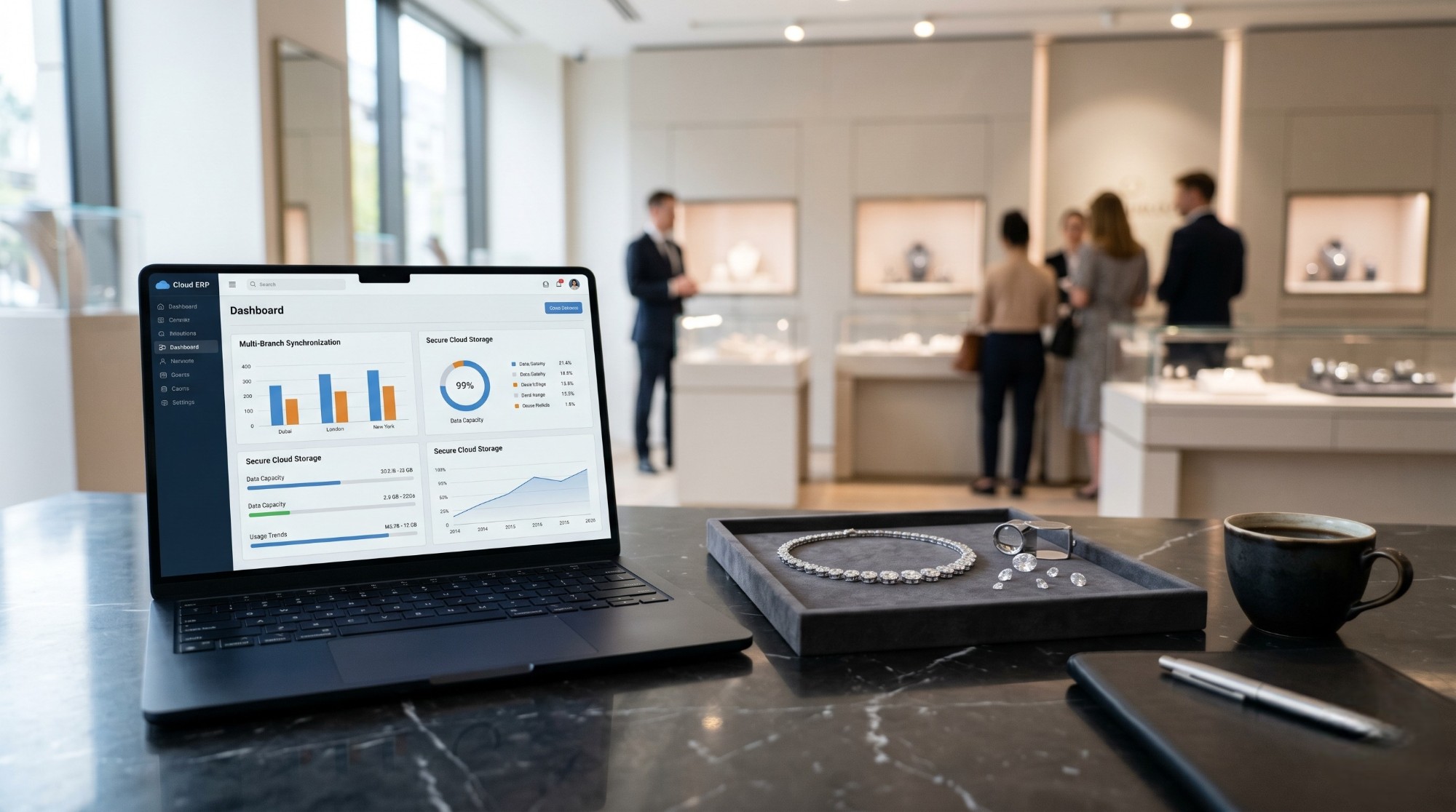
Multi-store operations are the primary domain of cloud technology. Because all branches connect to the same central, internet-hosted database, data synchronization is instantaneous. The moment a transaction is completed, whether it is a high-ticket diamond sale or a fast-moving silver chain, the global inventory is updated across the entire network in milliseconds.
This real-time visibility is crucial for managing diverse inventory. Utilizing a Cloud POS Silver system allows you to effortlessly track high-volume, lower-margin items that sell rapidly across multiple mall kiosks or boutique locations. At the same time, the cloud platform manages the slow-moving, high-margin Diamond ERP workflow, ensuring that unique, serialized stones are tracked with absolute precision. Implementing ERP solutions for retail expansion ensures that, whether you are opening a new branch across the street or across the country, deploying the software takes minutes rather than weeks. Optimizing your precious metals inventory becomes seamless when you leverage New Inventory Management Technologies For Gold Stores. Silver shops with tighter margins than gold retailers often benefit most from a cloud jewelry ERP, since it avoids the upfront server cost of a local deployment. Ask us for a cost comparison specific to a silver-focused store.
4. Making the Ultimate Business Decision
Transitioning your technology infrastructure is not merely an IT upgrade; it is a strategic business decision that directly impacts your profitability and operational resilience. The jewelry sector, particularly the gold and diamond markets, relies heavily on accurate, real-time data to protect profit margins against volatile commodity markets. Your software must empower your business, not hold it back with hidden costs and technical limitations.
Streamlining Financials and Operations
Operating an efficient jewelry business requires immaculate financial tracking. The labor costs of creating mixed jewelry, the fluctuating daily price of gold, and the complex commissions for your sales staff must all be recorded without error. Traditional systems require hours of manual administrative work to reconcile the books at the end of every week.
A modern cloud platform acts as the central nervous system for your entire organization. Because it is universally connected, every sale, return, and inventory transfer instantly updates the general ledger. By utilizing automated daily financial journals, you eliminate the human error associated with manual data entry. Your accounting team gains real-time visibility into the company’s cash flow, enabling them to make precise, data-driven decisions regarding purchasing budgets and vendor payments.
Focusing on Craftsmanship and Sales, Not Servers
Ultimately, you entered the jewelry business to source breathtaking diamonds, design exceptional gold pieces, and build lifelong relationships with your clients. You did not enter the business to become a systems administrator. Every hour you or your management team spends troubleshooting a broken local server or managing complex software updates is an hour stripped away from clienteling, marketing, and revenue generation.
By adopting integrated gold and jewelry modules hosted in the cloud, you transfer the burden of technological maintenance to dedicated experts. You gain the freedom to focus entirely on scaling your brand, optimizing your sales floor, and delivering the flawless luxury experience your clients expect.
Conclusion
The debate between cloud and on-premise solutions has a clear victor for the modern retail environment. On-premise systems tether your business to expensive hardware, hidden maintenance costs, and severe security vulnerabilities. In contrast, Cloud Jewelry Software liberates your operations. It provides enterprise-grade Data security, eliminates unpredictable Server costs, ensures seamless Multi-store synchronization, and empowers your staff with continuous Auto updates. Making the strategic Business decision to migrate to the cloud is the most effective way to future-proof your jewelry enterprise, ensuring that your digital infrastructure is as brilliant, resilient, and enduring as the diamonds you sell.
FAQ
A: No. While a live internet connection is required for real-time syncing across multiple locations, modern cloud point-of-sale systems feature an offline mode. You can continue to process cash and basic card transactions locally, and the system will automatically sync the data to the cloud the moment your internet connection is restored.
A: Yes. Premium cloud ERPs are continuously updated by the provider to ensure compliance with the latest regional laws, such as automated electronic invoicing requirements, ensuring your business never faces compliance penalties due to outdated software.
A: Absolutely. Cloud software providers offer secure data migration services. They will extract your legacy data, format it properly, and securely import it into your new cloud environment, ensuring a smooth transition without losing your historical client records.
A: While cloud software involves a recurring monthly or annual fee, it is significantly cheaper over five years when you calculate the Total Cost of Ownership (TCO). You completely avoid the massive costs of buying physical servers, paying for commercial electricity, hiring dedicated Retail IT staff, and purchasing mandatory version upgrades.