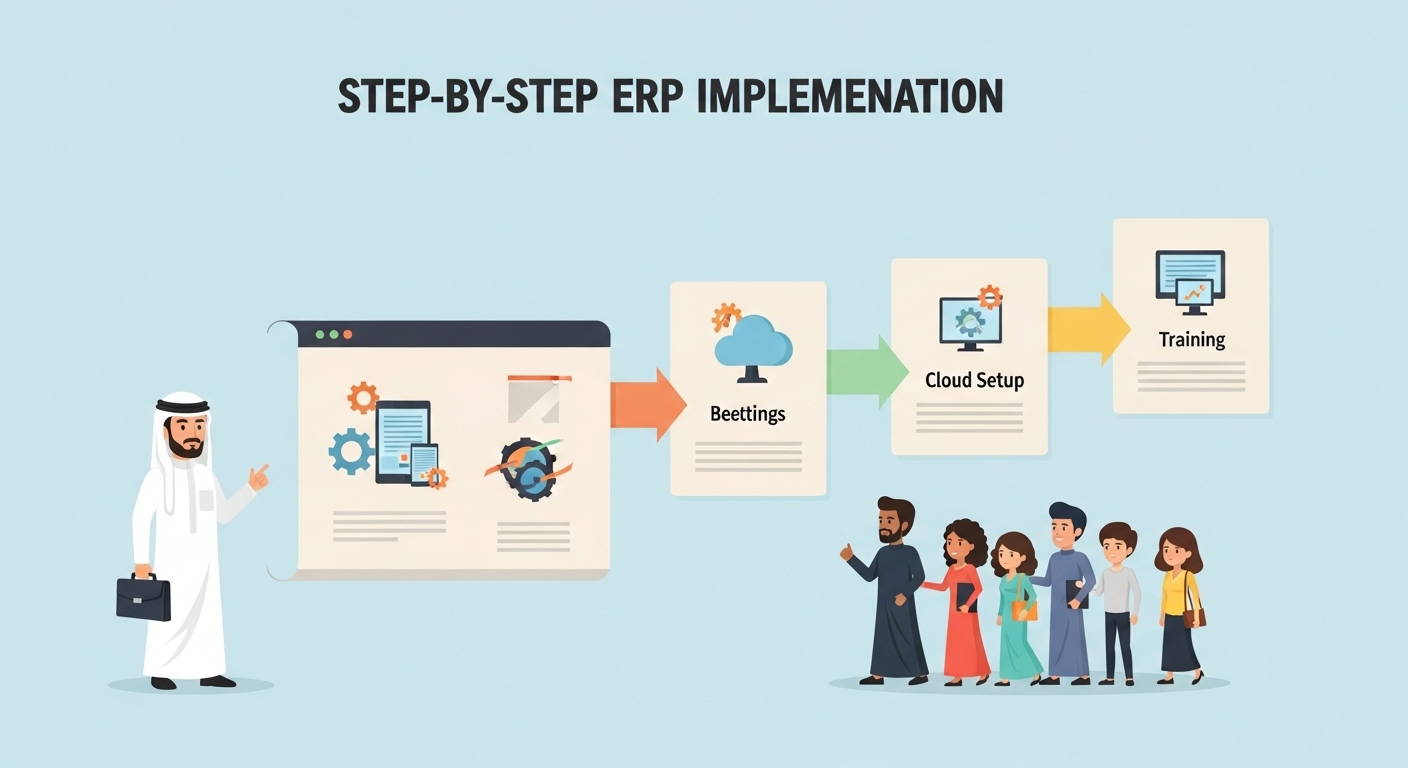
In the contemporary Saudi business landscape, digital maturity is no longer a peripheral goal — it sits at the centre of corporate strategy. As the Kingdom advances toward Vision 2030, ERP systems have become standard for organisations seeking to eliminate operational silos. Among the available platforms, Odoo has emerged as a frontrunner because of its modularity, cost-effectiveness and open-source flexibility.
One truth holds regardless of platform: an ERP’s success is determined not by the software but by the precision of its execution. A smooth Odoo rollout turns disjointed operations into a unified, data-driven engine — but it requires disciplined planning. This is particularly true for Saudi firms that must navigate ZATCA compliance, Arabic language support and local labour law simultaneously.
This guide walks through the multi-phase journey of a professional Odoo ERP project in Saudi Arabia, giving executives and project managers a roadmap for making the investment pay back.
Why Implementation Strategy Matters More Than the Software
Many organisations treat an ERP purchase as a plug-and-play IT project. In reality, implementing Odoo is an organisational change. Success depends on aligning the software’s capabilities with the human processes it is meant to support.
A proper Odoo setup unlocks:
- Operational efficiency: automating repetitive tasks across sales, inventory and finance.
- Real-time visibility: giving leadership accurate dashboards for informed decisions instead of week-old spreadsheets.
- Regulatory adherence: ensuring every transaction meets the standards of e-invoicing in Saudi Arabia and Saudi Labour Law.
Without a structured implementation process, even capable software becomes a source of frustration — producing data silos, user resistance and wasted budget.
The Six-Stage Odoo Implementation Process
A well-run implementation follows a methodology that reduces risk at every turn. These are the six stages of a successful rollout.
1. Discovery and Business Analysis
The journey begins with a deep look at the current state of the business. During discovery, consultants work with department heads to identify existing workflows, chronic pain points and specific regional requirements.
- ZATCA and GOSI needs: analysing how the firm currently handles VAT and social insurance so the future system automates both correctly.
- Gap analysis: mapping current manual processes against Odoo’s standard features to determine where customization is genuinely necessary and where process re-engineering is the better answer.
- Strategic mapping: defining the future state — how the business will operate once the digital backbone is in place.
2. Design and Solution Blueprinting
Once requirements are clear, the architectural blueprint is drawn. This phase defines the technical and functional scope of the project.
- Module selection: choosing the specific Odoo apps (Accounting, Inventory, CRM, Manufacturing and others) that will form the core of the system.
- Role-based access: defining exactly what each user can see and do, to protect data and prevent internal fraud.
- Reporting architecture: determining which KPIs matter to management and designing the dashboards that display them.
3. Configuration and Localization
This is where the heavy lifting of technical setup happens. Standard Odoo is a global product; configuration is what makes it a Saudi product.
- UI customization: adjusting the interface for usability and ensuring a clean Arabic right-to-left experience for local staff.
- Local tax rules: applying Saudi VAT treatment, including the requirements of ZATCA Phase 2 e-invoicing (the Integration Phase).
- HR localization: configuring cloud HRMS solutions to handle Saudi specifics such as End of Service Benefits, Muqeem integration and the Wage Protection System.
4. The Data Migration Challenge
Data is the lifeblood of an ERP, and moving it from legacy systems or fragmented spreadsheets is the most underestimated part of implementation.
- Data cleansing: identifying and removing duplicate customer records, outdated supplier information and inaccurate product descriptions.
- Mapping and upload: ensuring historical data fits Odoo’s database structure. Clean data at launch is what gives the system one source of truth from day one.
5. Training and User Acceptance Testing (UAT)
A system is only as good as the people using it. Training must be hands-on and tailored to specific job roles.
- Bilingual sessions: training in both English and Arabic so comprehension is complete across a diverse workforce.
- UAT with real scenarios: users test the system with their actual daily tasks. If a salesperson cannot process an order or a warehouse worker cannot receive a shipment during UAT, the system is not ready for launch.
6. Go-Live and Hypercare Support
The production launch is the culmination of months of work — but implementation does not end when the switch is flipped.
- The cutover: moving finalised data to the live server and transitioning the team to the new system.
- Dedicated monitoring: a hypercare period where consultants remain on-site or on-call to resolve immediate issues, answer user questions and confirm the system performs under the pressure of daily live operations.
A rollout is only as strong as its execution — explore Daysum’s Gold ERP Implementation Success Story and plan your own smooth go-live.
Strategic Comparison: Implementation Pitfalls vs. Daysum Solutions
The path to digital transformation is littered with common mistakes. Understanding these pitfalls lets a business avoid them deliberately.
|
Common pitfall |
The consequence |
The Daysum prevention strategy |
|
Unclear strategic goals |
The system is built without a purpose, leading to weak ROI. |
Defining measurable KPIs and business objectives during Phase 1. |
|
Poor workflow mapping |
Software and human processes clash, causing friction. |
Documenting and optimising processes before any code is written. |
|
Inadequate training |
Employees resist the system or use it incorrectly, corrupting data. |
Bilingual, hands-on workshops and role-specific manuals. |
|
Over-customization |
The system becomes too complex, expensive and hard to upgrade. |
Staying with standard Odoo features wherever possible; customising only for competitive advantage. |
|
Lack of compliance |
Fines from ZATCA or labour authorities due to incorrect setup. |
Local expertise in ZATCA Phase 2 and Saudi Labour Law automation. |
Stakeholder Alignment and Change Management
An ERP implementation is far more a people project than a technology project. Stakeholder alignment is what separates a rollout that sticks from one that gets quietly bypassed.
- Involve department heads early: if the finance manager or the warehouse director feels the system was imposed on them, they will not champion it. Involving them during discovery ensures the system solves problems they actually have.
- Appoint internal champions: identify super users in each department who are capable and influential. They become the first line of support for their colleagues.
- Communicate the why: management must explain the purpose of the change across IT, finance and operations, so adoption replaces resistance.
Realistic Timelines for a Professional Rollout
A fast implementation is often a failed one. Quality takes time, though Odoo’s modularity allows faster deployment than traditional Tier-1 ERPs. The schedule below reflects a standard scope — core finance, sales, inventory and purchasing for a single company.
|
Phase |
Estimated duration |
Key deliverable |
|
Discovery and analysis |
Weeks 1 – 2 |
Signed Business Requirement Document (BRD) |
|
Design and configuration |
Weeks 3 – 5 |
Configured sandbox environment for testing |
|
Migration and training |
Weeks 6 – 8 |
Cleaned database and certified super users |
|
Launch and support |
Weeks 9 – 12 |
Live production system with ongoing helpdesk |
Scope drives the schedule. Add manufacturing routing, multi-company consolidation, several legacy systems to migrate or heavy third-party integrations, and the same six stages simply take longer — typically extending the second half of the plan rather than the discovery phase.
Daysum’s KSA Advantages: Why a Local Partner is Non-Negotiable
Odoo is global software; the Saudi business environment is specific. Partnering with a local expert provides advantages that a remote vendor cannot replicate:
- Localised ZATCA expertise: we do not merely support e-invoicing; we configure the system to integrate with the Fatoora platform so Phase 2 clearance and reporting run inside your normal workflow.
- Arabic project management: project managers who work in the local language and understand local business etiquette, which removes a great deal of friction from coordination.
- Data residency guidance: many Saudi firms have requirements about where data physically resides. We offer both cloud and on-premise deployment, and we help you verify that the chosen hosting arrangement matches your sector’s obligations rather than assuming it does.
- Industry-specific tailoring: whether you are in manufacturing, services, or need a specialised setup for retail inventory, sales and compliance, our teams work from pre-built frameworks that shorten the rollout.
Budgeting and the Total Cost of Ownership (TCO)
A realistic budget must go beyond the initial software licence. To measure real return, account for the full lifecycle of the ERP.
- Licences: the cost of the Odoo subscription.
- Implementation and development: the one-time cost of analysis, configuration and any necessary customization.
- Training and infrastructure: the cost of educating the team and setting up servers, whether cloud or on-premise.
- Post-launch support: ongoing investment in helpdesk support, system optimisation and annual version upgrades.
Investing properly in implementation upfront is what prevents the far larger hidden costs of system failure and compliance penalties later.
Conclusion: Tailoring Success with Daysum
Implementing Odoo ERP is one of the most significant steps a Saudi company can take toward operational control and regulatory security. Following a structured six-stage process — from discovery through hypercare — is what converts daily operational friction into automated routine.
The technology, however, is only the tool; the implementation is the craft. Whether you are a manufacturer or a retailer needing a specialised gold accounting software setup, Daysum shapes the Odoo rollout around how the Saudi market actually works.
Ready to plan your rollout properly? Book a consultation with Daysum today for a scoped, compliant implementation plan built around your business.
Frequently Asked Questions (FAQs)
While simple rollouts can be completed in 8 weeks, a comprehensive implementation for a mid-to-large Saudi enterprise typically takes 12 to 16 weeks. This timeline ensures adequate time for deep localization, complex data migration, and thorough user training, which are essential for long-term success.
Yes, but it requires professional configuration. Standard Odoo needs to be integrated with a compliant "EGS" (Electronic Generation Solution) unit that speaks to ZATCA's API. A certified local partner like Daysum ensures this integration is automated, so your staff doesn't even notice the cryptographic clearance happening in the background.
Absolutely. One of Odoo's greatest strengths is its scalability. Small businesses can start with just one or two modules (like Sales and Accounting) and add more apps (like Inventory or HR) as they grow. This "start small, scale fast" approach minimizes initial costs while future-proofing the business.
Cloud implementation (SaaS or Odoo.sh) is faster and requires no internal server maintenance, making it ideal for most businesses. On-premise implementation involves installing Odoo on your own local servers, which is often preferred by government entities or large corporations with strict internal data security protocols. Daysum supports both models, ensuring full data residency compliance.
The cost is divided into two parts: the Odoo subscription (license) and the implementation services. Implementation costs vary based on the number of modules, the complexity of data migration, and the level of customization required. Investing in a professional rollout with a local partner typically pays for itself within the first year through improved efficiency and the avoidance of compliance fines.