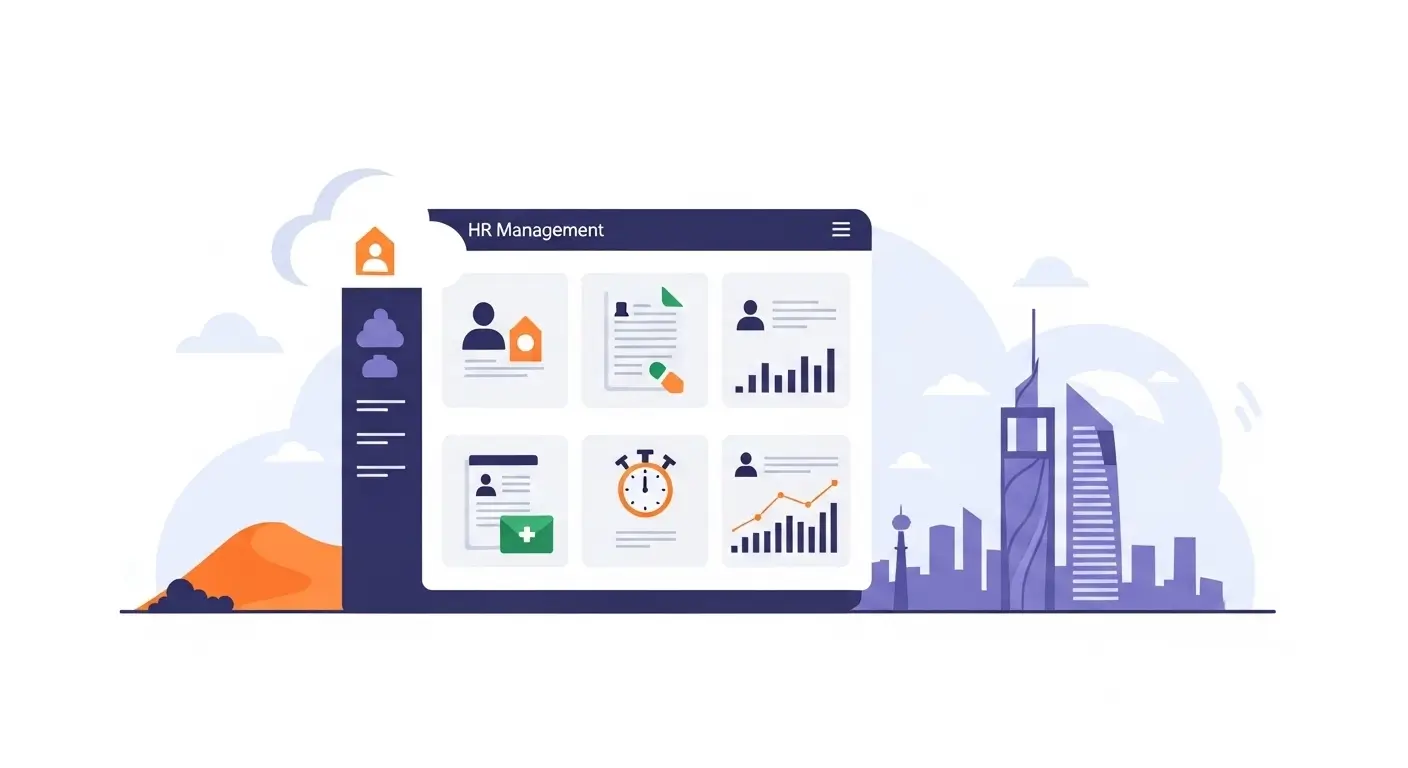
HRMS cloud solutions in Saudi Arabia have shifted from a nice-to-have luxury to a fundamental operating requirement. In the high-velocity economy of the Kingdom, the “Future of Work” is not found in filing cabinets or convoluted Excel spreadsheets — it lives in the cloud. From the retail sectors of Riyadh to the industrial powerhouses in Jubail, employers are moving workforce management into a single digital ecosystem.
A Cloud Human Resource Management System (HRMS) automates the heavy lifting — payroll, attendance and regulatory compliance — while empowering employees through self-service portals. This guide covers what a modern system must include, how implementation actually works, and what compliance obligations it has to absorb on your behalf.
What Exactly is a Cloud HRMS?
At its most basic level, a Human Resource Management System (HRMS) is an integrated digital platform that centralises the entire employee lifecycle. Instead of one software for payroll, another for recruitment and a physical folder for employee contracts, a Cloud HRMS pulls every data point into one secure, synchronised system.
“Cloud” is the operative word. Unlike legacy systems that required expensive on-site servers, a cloud-based system is hosted securely on the web, so whether your HR manager is in the office or at a remote site, the data stays accessible, accurate and real-time. In a successful Odoo ERP implementation in Saudi Arabia, the HRMS module acts as the heart of the ERP: every time a new hire joins or a salary is adjusted, the finance and operational modules reflect that change instantly.
Key Features of a Modern Saudi HRMS
A generic, global HR package often fails to survive the specific rigours of the Saudi market. A truly effective system must be Saudi-optimised, meaning it understands the nuances of local labour law and workplace practice. These are the core features that define a high-performing system:
A. Automated Payroll (The Compliance Engine)
Payroll in Saudi Arabia is uniquely complex. It is not simply hours multiplied by a rate. It involves:
- Saudi Labour Law logic: automatic calculation of overtime at the statutory premium (Article 107), annual and sick leave entitlements (Articles 109 and 117), housing and transport allowances, and end-of-service benefits (Articles 84-87).
- GOSI integration: precise calculation of social insurance contributions for both Saudi nationals and expatriates, at their respective contribution rates.
- WPS (Wage Protection System) alignment: generating SIF (Salary Information Files) formatted correctly for bank transfer, so your firm never triggers a Ministry of Human Resources audit flag.
B. Intelligent Attendance Tracking
The days of manual punch cards are long gone. Modern systems use:
- Biometric and geofencing capture: integration with office fingerprint scanners or mobile GPS clock-in for field staff.
- Leave management: an automated workflow where employees request leave and the system instantly checks the remaining balance before routing the request to their manager.
- Shift and roster planning: matching attendance rules to rotating shifts, Ramadan hours and site-based teams without manual timesheet rebuilds.
C. The Employee Self-Service (ESS) Portal
This is where the shift is felt by your staff. Employee self-service systems reduce the administrative burden on HR by letting employees handle routine requests themselves. An ESS portal allows employees to:
- Download digital payslips at any time.
- Request salary certificates or employment letters — a frequent requirement for bank financing in KSA.
- Update personal documents (Iqama, passport, driving licence) before they expire.
D. Strategic Recruitment and Onboarding
A Cloud HRMS turns recruitment from a reactive task into a strategic advantage. It tracks a candidate from the moment they apply on your website to the day they sit at their desk, managing interviews, offer letters and digital contract signing in alignment with GOSI and Qiwa in a single flow.
E. Performance and Talent Management
Performance reviews are no longer a once-a-year headache. A modern cloud HRMS supports continuous feedback, goal and KPI tracking, and 360-degree reviews, so your strongest performers are recognised and developed rather than lost to a competitor.
The Implementation Journey: A Five-Phase Roadmap
Moving to a Cloud HRMS is a journey, not a switch. To secure a strong return and avoid operational downtime, implementation must be structured.
|
Phase |
Objective |
Outcome |
|
1. Discovery |
Mapping existing workflows and pain points. |
A clear blueprint of “needs vs. wants”. |
|
2. Configuration |
Tailoring the software to company-specific policies. |
A system that speaks your company’s language. |
|
3. Migration |
Secure transfer of historical employee data. |
A clean, validated database of your workforce. |
|
4. Training & UAT |
Hands-on sessions and user acceptance testing. |
Confident staff and a validated system. |
|
5. Go-Live |
The official launch of the production system. |
A fully digitised HR department. |
For many Saudi firms, especially those in the gold and jewellery sector, this implementation should be paired with a specialised gold ERP for jewellery businesses to manage the intersection of sales-staff performance and commissions calculated on precious metal values.
Cloud vs. On-Premise: The Verdict
While some organisations still hold on to physical servers, the case for the cloud is now decisive. For companies that must maintain e-invoicing standards in Saudi Arabia, the cloud offers the agility needed to update tax logic the moment regulations evolve.
Comparison Table: Why Cloud Wins
|
Feature |
Cloud HRMS |
On-premise HRMS |
|
Accessibility |
24/7 access from any device (mobile or web). |
Access typically restricted to the office network. |
|
Maintenance |
Handled by the provider; minimal IT burden. |
Requires internal IT staff, cooling and hardware. |
|
Security |
Encrypted at rest and in transit; automated backups. |
Exposed to physical theft or local server failure. |
|
Updates |
Automatic — ZATCA and GOSI changes pushed live. |
Manual updates; often requires paid consultants. |
|
Cost model |
Subscription-based (Opex). |
High upfront hardware and licence cost (Capex). |
Regulatory Compliance: ZATCA, GOSI, and Nitaqat
In Saudi Arabia, an HRMS is more than an organisational tool; it is a shield against legal liability. The Ministry of Human Resources and Social Development (MHRSD) has digitised almost every aspect of labour compliance, which is why aligning your HR system with Saudi labour law is a board-level concern rather than an administrative one.
- ZATCA integration: while HR manages people, the financial output of HR (payroll) must align with ZATCA Phase 2 e-invoicing requirements for accurate expense reporting and tax auditing.
- Iqama and visa tracking: a Saudi-optimised system issues proactive alerts 90, 60 and 30 days before an expatriate’s documents expire, preventing the frozen-file scenario that can halt operations.
- Nitaqat (Saudisation): real-time monitoring of your Saudisation ratio helps you hold a favourable band, protecting your ability to issue new visas or transfer employees.
The Daysum Advantage: Your Local HR Architect
Choosing the right software is half the battle; choosing the right implementation partner is the other half. At Daysum, we do not simply install an HRMS — we design a workforce operating model around it.
A Saudi company has different needs from a European or American one. Our solutions are built to handle:
- Arabic-first interface: HR staff and employees work comfortably in their native language, with full right-to-left support.
- Local bank integrations: payroll connects directly to major KSA banks for one-click salary disbursement through WPS-compliant files.
- Scalability: whether you have 10 employees or 10,000, our Odoo-based systems scale without a disproportionate jump in cost.
- Local support: questions about a GOSI update or a WPS rejection go to Daysum experts inside the Kingdom, not an offshore call centre.
Simplify workforce management and payroll processing using our secure HRMS cloud solutions KSA.
Conclusion: From Burden to Advantage
The administrative burden of HR — the endless paperwork, the manual payroll errors, the compliance anxiety — is a drag on growth. By moving to a Cloud HRMS, you convert HR from a cost centre into a talent centre.
You give employees self-service, protect the business with automated compliance, and gain the workforce data needed to plan headcount, cost and Saudisation with confidence.
Ready to modernise your HR operations? Contact Daysum today for a personalised consultation and see how a Saudi-optimised Cloud HRMS fits your workforce.
Frequently Asked Questions
Yes. When implemented by a local partner like Daysum, we ensure that your data is hosted on servers that comply with the Kingdom's Data Residency regulations. We prioritize local cloud infrastructure (such as Google Cloud's Saudi region) to ensure that sensitive employee data never leaves the Kingdom.
This is a standard feature in our Saudi-optimized HRMS. The system automatically tracks the employee’s start date, their contract type (limited or unlimited), and their final salary. Upon termination or resignation, it calculates the exact EOSB amount according to the current Saudi Labor Law, including the distinction between the first five years and subsequent years.
Absolutely. Most modern biometric devices support API or cloud-syncing capabilities. During the implementation phase, we bridge your physical devices with the HRMS, allowing attendance data to flow in real-time. This eliminates the need for manual time-sheet entries and ensures payroll accuracy.
While HR focuses on employees, the payroll records generated are essential for your corporate accounting. Our systems ensure that all payroll-related expenses are correctly categorized and ready for integration with your ZATCA-compliant e-invoicing and accounting modules, providing a unified financial trail for audit purposes.
For an SME (Small to Medium Enterprise) with standard requirements, a full rollout—including configuration, migration, and training—typically takes 6 to 8 weeks. Larger organizations with complex multi-branch requirements or extensive custom workflows may take 12 weeks or more. We prioritize a phased approach to ensure your current payroll cycle is never interrupted.