In the world of high-end retail, the most complex challenge for a jeweler isn’t necessarily the sale itself—it is the math that happens before the item ever reaches the display case. When dealing with a plain gold band, the pricing is relatively straightforward: weight multiplied by the daily market rate, plus a markup. However, the moment you introduce gemstones, the complexity scales exponentially. Mixed Jewelry Pricing is a delicate science that balances the volatile commodity price of gold with the subjective, graded value of diamonds and other precious stones.
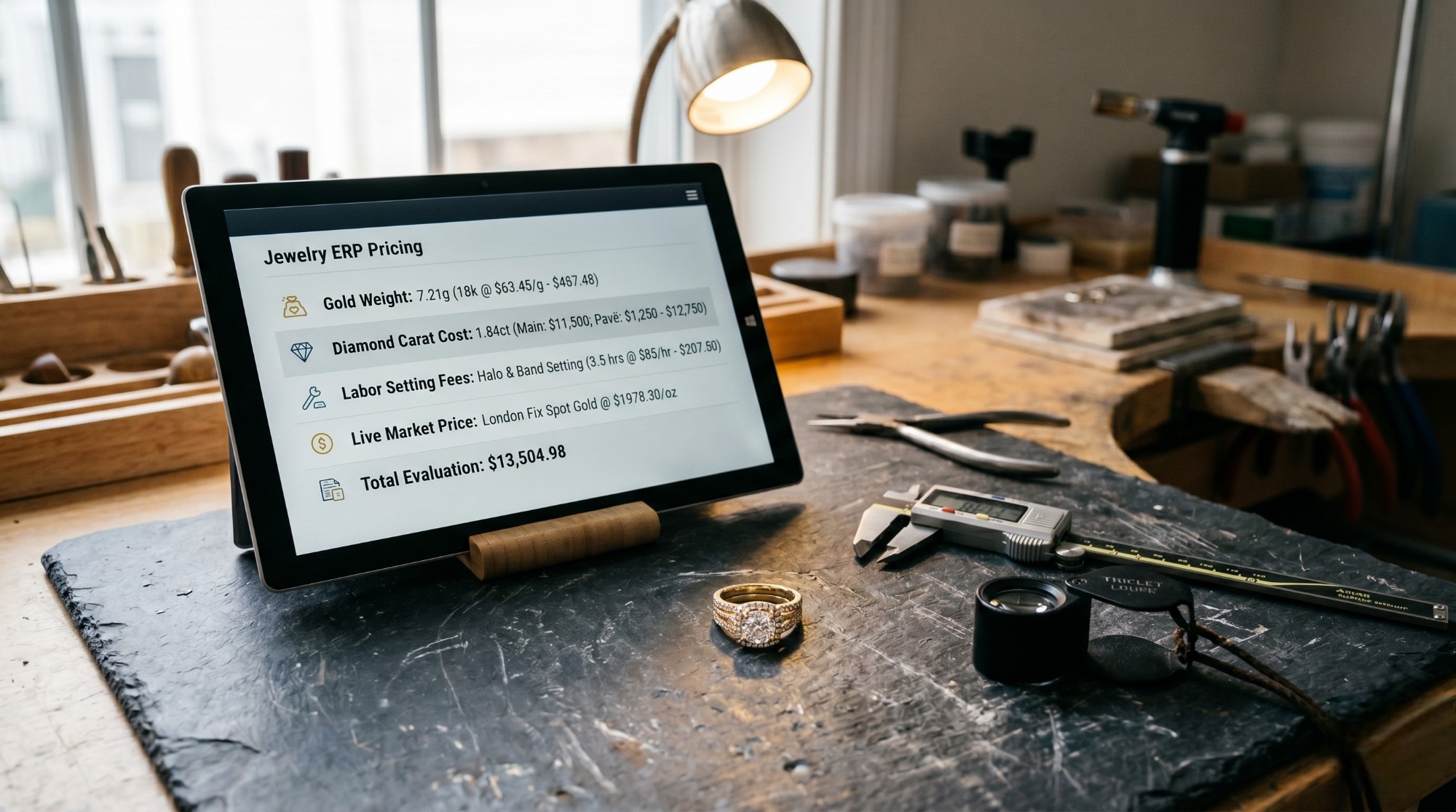
For a modern jewelry business, relying on manual calculations or static spreadsheets to price these items is a recipe for financial leakage. A slight fluctuation in the gold spot price or an error in calculating the “making charges” for a complex setting can instantly erase your profit margin. To maintain a competitive edge, retailers are increasingly turning to advanced Mixed Jewelry Pricing software systems. These tools allow for a granular breakdown of every component—from the 18K gold casting to the individual clarity of the pavé diamonds—ensuring that every piece is priced to reflect its true artistic and material value.
1. The Metal vs. Stone Dilemma: Balancing Two Markets
The fundamental difficulty in pricing mixed jewelry is that you are dealing with two entirely different market behaviors. Gold is a commodity; its price changes by the minute based on global economic factors. Diamonds, on the other hand, are valued based on the 4Cs (Carat, Color, Clarity, and Cut), and their prices tend to move in steps rather than fluid curves.
Pricing the Gold Component (18K and 14K Standards)
Most diamond-set jewelry is crafted in 18K or 14K gold because pure 24K is too soft to hold stones securely. When calculating the metal portion of the Piece cost, you must account for the “purity factor.” For 18K gold, you are essentially pricing 75% pure gold and 25% alloy.
A sophisticated Mixed Jewelry Pricing system automatically pulls live market feeds for pure gold and applies the purity conversion instantly. This ensures that if the gold price spikes while an item is sitting in your inventory, your sales software can suggest a price adjustment in real-time, protecting your replacement cost and ensuring you aren’t selling today’s luxury at yesterday’s lower gold rates.
Valuing Gemstones and Diamonds
Unlike gold, gemstones aren’t priced by a universal gram rate. Each stone in a mixed piece must be accounted for individually. In a complex Jewelry design, such as a halo engagement ring, you might have one central 1.00ct diamond and thirty smaller melee diamonds.
The software must allow you to input Gemstone rates based on specific batches or individual certifications (like GIA or IGI). By segregating the stone value from the metal value, you gain a clear picture of where the item’s worth truly lies. This transparency is vital during the sales process; when a customer asks why two similar-looking rings have vastly different prices, you can show them exactly how the diamond’s color grade or the gold’s gram weight justifies the premium.
2. The Art of Design Cost Calculation: Beyond Materials
If you price jewelry solely based on the sum of its raw materials, you are ignoring the most expensive part of the process: craftsmanship. In the jewelry trade, this is often referred to as “Making Charges.”
Factorizing, Making Charges, and Labor
Setting a diamond into an 18K gold mounting requires a master setter’s skill. The more stones a piece has, the higher the labor cost. Mixed Jewelry Pricing software must include a dedicated module for making charges. These charges can be calculated in three ways:
- Per Gram: Common for simpler gold-heavy designs.
- Per Piece: A flat fee for the entire design regardless of weight.
- Per Stone: Specifically for labor-intensive settings like pavé or channel settings, where the work is measured by the number of stones set.
By utilizing automated daily journal control, these labor costs are recorded as part of the asset’s value, ensuring your accounting department understands the total investment in every SKU.
Accounting for “Wastage” and Casting Losses
When a piece of jewelry is designed, gold is lost during the polishing, filing, and casting processes. This is known as “wastage.” If a ring starts as 6 grams of raw gold and ends as a 5.5-gram finished product, that 0.5 gram of lost gold must be factored into the final price.
Traditional jewelers often add a flat 10% or 15% wastage fee. However, advanced Sales software allows for more precise wastage calculations based on the complexity of the design. A simple wedding band has very little wastage, whereas a highly intricate filigree pendant might have a much higher percentage. Accurately capturing this “invisible” cost is a hallmark of a profitable jewelry business. Pieces that combine gold, gemstones, and fixed labor charges need pricing logic that treats each component separately, not one flat markup. Request a demo showing mixed-item pricing on a real product from your catalog.
3. Setting Strategic Profit Margins
Once you have the total cost—metal + stones + labor + wastage—you must apply a markup. Setting Profit margins for mixed jewelry is more psychological than mathematical.
The Luxury Markup Strategy
Mixed jewelry often commands a higher markup than plain gold. This is because the “perceived value” of a diamond-set piece is higher. Customers expect to pay a premium for the curation of stones and the exclusivity of the design.
In a competitive market, you might choose a tiered margin approach:
- High-Volume Silver/Gold: Lower margins (e.g., 20-30%) to encourage turnover.
- Bridal and Engagement: Moderate margins (e.g., 40-60%) where brand trust and service are key.
- High-Jewelry/One-of-a-Kind: High margins (100%+) where the rarity of the central stone and the uniqueness of the Jewelry design justify a luxury price point.
Competitive Analysis and Pricing Adjustments
Your pricing doesn’t exist in a vacuum. You must constantly monitor competitor rates and market trends. If a specific style of 18K diamond necklace becomes a global trend, the market value might rise above your standard margin calculation.
Using data-driven, specialized gold and jewelry modules, you can run reports to see which price points have the highest “sell-through” rate. If your data shows that mixed pieces priced between $2,500 and $3,500 sell twice as fast as those outside that range, you can adjust your design and sourcing strategies to hit that “sweet spot” more consistently.
4. The Role of ERP Automation in Pricing Accuracy
The era of the “price tag on a string” is over. In a modern retail environment, pricing must be dynamic, digital, and instantly verifiable. This is where ERP (Enterprise Resource Planning) automation becomes the jeweler’s greatest ally.
Real-Time Market Updates
The most significant benefit of a Mixed Jewelry Pricing software system is its ability to update prices instantly. When the global gold market fluctuates, the system recalculates the price of every gold item in your inventory based on its specific weight. This protects you from “under-selling” when the market is up and ensures you remain competitive when the market is down.
Compliance and Transparent Billing
For businesses operating in the Middle East, pricing isn’t just about profit; it’s about compliance. When a customer purchases a high-value mixed piece, the invoice must clearly break down the VAT, the metal value, and the gemstone value to meet ZATCA-approved e-invoicing standards.
This transparency builds immense trust with the customer. When they see a detailed receipt that accounts for every gram and every stone, they feel confident that they are paying a fair, market-regulated price. It also ensures that your business is fully prepared for any financial audits, as every transaction is backed by the raw data used to generate the price.
Eliminating Human Error
Manual pricing is prone to mistakes. A salesperson might misread a stone’s weight, or an accountant might forget to include the setting fee in the final cost. In the jewelry industry, a $100 error on a $1,000 item is a 10% loss of revenue.
Automated pricing eliminates these risks. The software acts as a “single source of truth.” When a new piece is entered into the system, the weight is verified, the stone certifications are attached, and the price is calculated based on preset formulas. The salesperson simply scans the barcode, and the correct, compliant price appears on the screen, allowing them to focus on the customer rather than the calculator. For modern jewelers looking to increase profitability, we highly recommend reading about Prevent Jewelry Theft ERP System.
Conclusion
Pricing mixed jewelry is one of the most intellectually demanding tasks in the retail industry. It requires a deep understanding of commodity markets, gemstone grading, and high-precision craftsmanship. By moving away from manual methods and embracing a dedicated Mixed Jewelry Pricing software system, you ensure that your business is protected from market volatility and human error. Whether you are selling a simple 18K gold pendant or a multi-carat diamond masterpiece, an automated, data-driven approach to pricing is the only way to ensure your design margins remain as brilliant as the stones you sell.
FAQ
A: A flat markup ignores the reality of mixed pieces. A diamond ring with high labor costs and low gold weight needs a different margin structure than a heavy gold chain with no stones. Using a flat rate often results in overpricing simple items and underpricing complex ones.
A: Wastage accounts for the gold lost during manufacturing. If you don't factor in a 10-15% wastage fee, you are essentially losing 10-15% of your metal investment on every piece you create.
A: Generally, yes. 18K gold is an alloy of 75% gold and 25% other metals, making it significantly harder and more durable for holding diamonds securely. 21K is often too soft for complex "mixed jewelry" designs.
A: Absolutely. A robust Mixed Jewelry Pricing system allows you to link GIA or IGI certificate numbers directly to the piece, ensuring the stone's specific characteristics are part of the valuation.