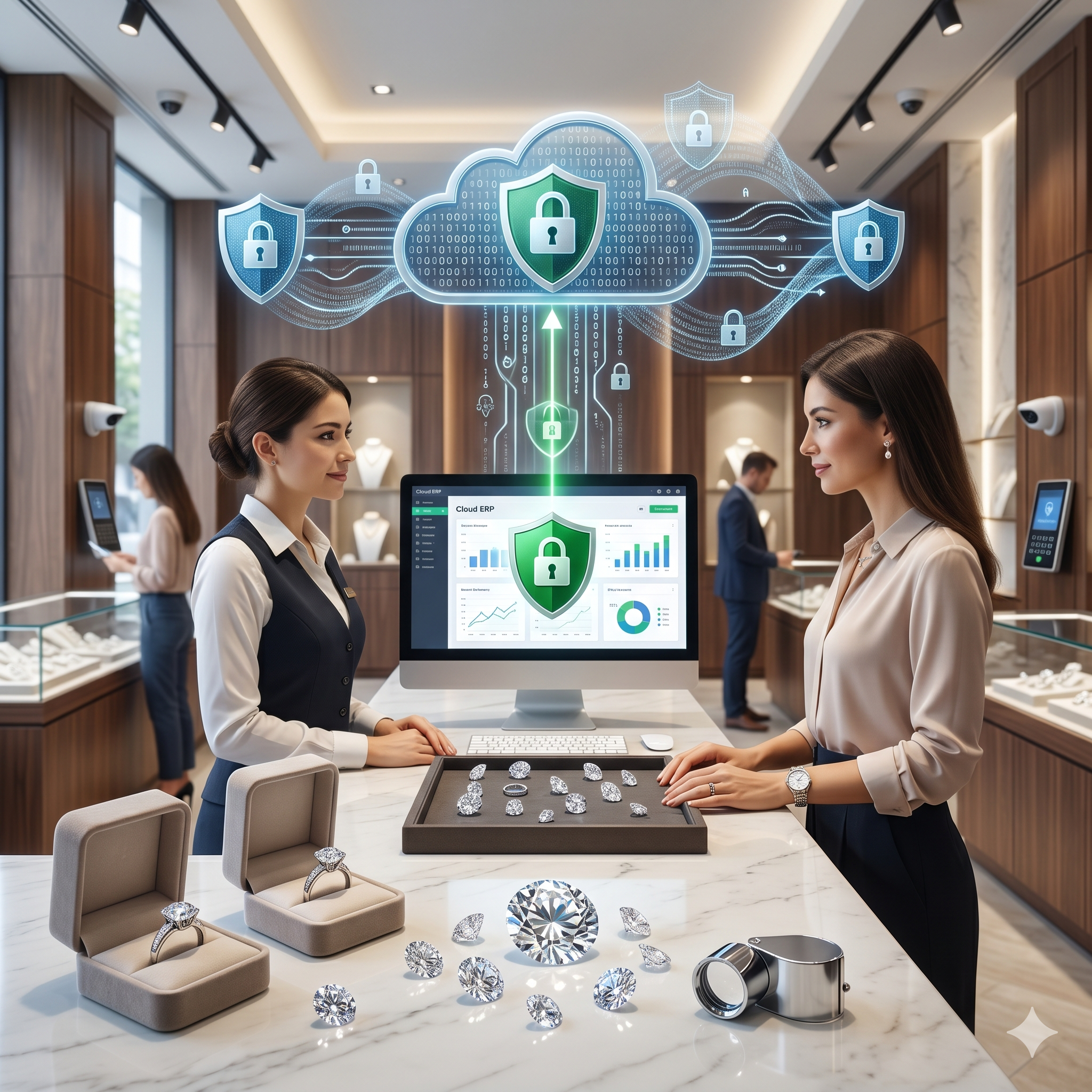
In the high-stakes world of fine jewelry and diamonds, physical security has always been a paramount concern. Store owners invest heavily in biometric safes, armed transport, shatterproof glass, and high-definition surveillance systems. However, as the retail industry undergoes a rapid digital transformation, the concept of the “vault” has fundamentally changed. Today, a jewelry brand’s most valuable asset is not just the diamonds in the display case, but the digital data stored on its servers.
Customer purchase histories, ring sizes, anniversary dates, high-net-worth individual (HNWI) profiles, unreleased custom CAD designs, and precise wholesale margin calculations are highly lucrative targets for modern cybercriminals. A physical robbery might result in the loss of a few pieces of inventory, covered by insurance. A digital data breach, however, can result in the catastrophic loss of client trust, severe regulatory fines, and irreparable damage to the brand’s reputation.
As jewelers transition from outdated manual ledgers to sophisticated, centralized digital platforms, prioritizing Jewelry Data Security is no longer optional. Implementing a modern Cloud ERP system is the most effective way to secure your digital assets. This comprehensive guide explores the anatomy of digital threats in the jewelry sector and how advanced encryption, strict user permissions, and automated backups act as an impenetrable digital fortress for your business.
1. Understanding Data Leak Risks in High-Value Retail
Before you can defend your business, you must understand the nature of the threat. The jewelry sector is a unique target for cyberattacks because of the immense concentration of wealth it represents, both in physical inventory and in the financial profiles of its clientele.
The True Cost of a Data Breach
When a hacker infiltrates a standard retail store, they might acquire credit card numbers. When they infiltrate a high-end diamond boutique, they acquire a roadmap to the city’s wealthiest individuals. Hackers can leverage client purchase histories to execute highly targeted phishing campaigns, or worse, use the data to facilitate physical robberies at clients’ homes by knowing exactly what high-value items they recently purchased.
The financial fallout for the jeweler is devastating. Beyond the immediate loss of operational capabilities, regulatory bodies heavily penalize businesses that fail to protect consumer data. In the Middle East, compliance with stringent data protection frameworks is mandatory. A breach can result in massive fines, legal settlements, and the loss of merchant processing privileges. Ultimately, the loss of reputation is the most expensive consequence; a VIP client who loses trust in your discretion will simply take their business to a competitor.
Ransomware and the “Digital Hostage” Scenario
One of the most pervasive threats to Cloud ERP systems and retail technology is ransomware. In a ransomware attack, malicious software encrypts your entire database—locking you out of your inventory system, your point-of-sale (POS), and your client records. The hackers then demand a massive financial ransom in exchange for the decryption key.
For a jewelry store, downtime is incredibly expensive. If a store cannot access its pricing matrix, verify inventory, or process secure payments during a busy holiday season, the business grinds to a halt. Small vulnerabilities, such as an employee clicking on a phishing email disguised as a vendor invoice, can introduce this malware into an unprotected network.
Insider Threats and the “Slow Leak”
Not all threats come from shadowy hackers halfway across the world. Often, the most dangerous risks are internal. This is particularly relevant in the jewelry trade, where margins, supplier contacts, and VIP lists are highly guarded secrets. An insider threat could be a malicious employee attempting to steal client lists before leaving to start a competing business, or it could be a negligent employee accidentally emailing an unencrypted spreadsheet of financial data to the wrong person.
Protecting your business requires a holistic approach that defends against both external cyber syndicates and internal vulnerabilities. The integration of physical PropTech (Property Technology)—such as RFID inventory scanners and smart cameras—with your digital ERP system creates a unified security perimeter that monitors both the physical and digital movement of your assets.
2. The Power of Cloud Encryption: Your Digital Vault
Historically, jewelers preferred on-premise servers, believing that if they could physically see the blinking lights of the server in their back office, the data was safe. In reality, on-premise servers are highly vulnerable to localized disasters (fires, floods), physical theft, and sophisticated cyberattacks unless maintained by a dedicated, full-time cybersecurity team.
The modern standard for Jewelry Data Security is the cloud. By migrating to a Cloud ERP system, jewelers outsource the heavy lifting of cybersecurity to dedicated experts who operate in world-class, heavily guarded data centers.
End-to-End Encryption Explained
The cornerstone of cloud security is encryption. Encryption scrambles your readable data (plaintext) into an unreadable format (ciphertext) using complex cryptographic algorithms. Even if a hacker manages to intercept the data, it appears as absolute gibberish without the specific decryption key.
A robust ERP system utilizes encryption in two critical phases:
- Data at Rest: This protects the data stored on the servers. Advanced Encryption Standard (AES-256) is the global standard used by banks and militaries. If your ERP utilizes AES-256, your stored client profiles, diamond certificates, and financial ledgers are virtually impenetrable.
- Data in Transit: This protects the data as it travels between your store’s computer and the cloud server. When a salesperson swipes a credit card or updates a client profile, that information is transmitted over the internet using Transport Layer Security (TLS). This ensures that the data cannot be intercepted or altered while in motion.
Secure API Integrations and Tax Compliance
A modern jewelry business does not operate in isolation; it must communicate with external platforms, from global diamond exchanges to local tax authorities. How this communication is handled is a massive security factor.
For example, jewelers operating in Saudi Arabia are required to integrate their billing systems with the Zakat, Tax, and Customs Authority (ZATCA) for electronic invoicing. A poorly designed integration can act as a backdoor for hackers to enter your core financial system. Utilizing a system designed for encrypted e-invoice issuance and secure compliance ensures that the data sent to the government is heavily encrypted and authenticated via cryptographic stamping, fulfilling legal requirements without exposing your internal ERP architecture.
By relying on secure cloud hosting and customized solutions, you ensure that your digital infrastructure is monitored 24/7 by dedicated security professionals, utilizing AI-driven threat detection to identify and neutralize cyberattacks before they ever reach your store’s network.
3. Staff Permissions and Role-Based Access Control
The most robust encryption in the world is useless if you give the keys to everyone. In traditional, manual inventory systems, any employee who found the physical logbook could see exactly how much the business paid for a specific diamond. This lack of privacy severely compromises negotiating power and creates internal security risks.
The Principle of Least Privilege
Modern Cloud ERP systems solve this through Role-Based Access Control (RBAC). RBAC operates on the “principle of least privilege,” which states that a user should only be granted the absolute minimum level of access necessary to perform their specific job functions.
In a jewelry store environment, RBAC looks like this:
- The Sales Associate: Has permission to view the retail price, the carat weight, the ring size, and the general customer profile (name, past purchases) to facilitate the sale. They do not have permission to view the wholesale landed cost, the vendor contact information, or the customer’s full credit card details.
- The Inventory Manager: Has permission to view the wholesale costs, initiate purchase orders, and manage vendor relationships. They can adjust stock levels, but they cannot authorize financial refunds or alter the general ledger.
- The Financial Controller: Has full access to the accounting modules, daily journal entries, and tax reporting.
- The Business Owner: Possesses “Super Admin” privileges, with complete visibility across every department, dashboard, and audit log.
Preventing Unauthorized Access and Modifications
By enforcing strict User permissions, you drastically reduce your attack surface. If a junior salesperson’s account is compromised by a phishing attack, the hacker only gains access to a limited set of non-critical data, rather than the “keys to the kingdom.” Furthermore, RBAC prevents accidental data corruption. A new employee cannot inadvertently delete an entire category of silver inventory if their role does not grant them deletion privileges.
The Digital Audit Trail
A true comprehensive Jewelry ERP solution acts as a relentless digital watchdog. Every single action taken within the system—every price change, every inventory adjustment, every customer file accessed—is permanently logged with a timestamp and the user’s ID.
If a highly discounted diamond sale goes through, or if an inventory count shows a discrepancy in 18k gold chains, the management team does not have to guess what happened. They can instantly pull an audit report to see exactly which employee initiated the transaction or made the adjustment. This level of absolute accountability is the greatest deterrent to internal shrinkage and malicious data manipulation.
4. Automated Backups and Disaster Recovery
No system is entirely immune to failure. Whether it is a sophisticated zero-day cyberattack, a localized natural disaster, or a simple hardware malfunction at your store, you must operate under the assumption that a disruption will eventually occur. When it does, your survival depends entirely on your backup strategy.
The Importance of Automated Data Backups
In the past, backing up a jewelry store’s data meant an employee had to remember to plug in a physical hard drive at the end of the week, copy the files, and ideally, take the drive home. This manual process was prone to human error. If the employee forgot to run the backup for a month, and the server crashed, an entire month of sales data, new inventory entries, and client profiles were lost forever.
Modern Jewelry Data Security relies on automated, invisible processes. A cloud-based ERP automatically backs up your entire database multiple times a day—sometimes every hour—without requiring any human intervention. This ensures that your “restore point” is always incredibly recent, minimizing potential data loss to a matter of minutes rather than weeks.
The 3-2-1 Backup Strategy
Top-tier cybersecurity protocols rely on the industry-standard 3-2-1 backup rule. This ensures redundancy and total data resilience:
- 3: Keep at least three total copies of your data (the primary operational data and two backups).
- 2: Store the backups on two different types of storage media to prevent a single point of failure.
- 1: Keep at least one of those backups securely offsite (in the cloud).
By utilizing a cloud ERP, the “offsite” component is built in. Your data is not just stored in one physical server rack; it is duplicated and distributed across multiple geographically separate data centers. If a massive power grid failure takes down a data center in one region, the system instantaneously fails over to a secondary location, ensuring your store experiences zero downtime.
Neutralizing Ransomware and Ensuring Business Continuity
A rigorous backup strategy is the ultimate defense against ransomware. If a hacker manages to bypass your security and encrypts your local machines, demanding a ransom, you hold the trump card. You simply wipe the infected local machines clean, connect to your cloud ERP, and restore the pristine, unencrypted backup from an hour ago. The hackers lose their leverage, you pay no ransom, and your business is back online rapidly.
When VIP clients entrust you with creating their legacy pieces, they are also trusting you with their privacy. A visible, serious commitment to Jewelry Data Security, driven by automated backups and a clear disaster recovery plan, is a powerful selling point. It elevates your brand from a simple retail operation to a highly professional, secure institution.
Conclusion
As the jewelry industry hurtles into the future, the distinction between a jeweler and a technology manager is blurring. Protecting your high-value inventory is no longer just about heavy metal safes and security guards; it is fundamentally about cybersecurity. By migrating to a modern Cloud ERP system, you weaponize advanced encryption, enforce granular User permissions, and rely on automated Backups to protect your most sensitive asset: your data. In an era where digital trust is just as valuable as the diamonds you sell, investing in uncompromising data security is the ultimate strategy for long-term growth and brand preservation.
FAQ
A: Yes. On-premise servers are vulnerable to physical theft, fires, and lack the 24/7 dedicated cybersecurity monitoring that massive cloud data centers provide. The cloud utilizes military-grade encryption that is exceptionally difficult to breach.
A: RBAC streamlines your operations by removing distractions and preventing accidental errors. By only showing employees the modules they need (e.g., hiding wholesale costs from junior sales staff), you protect your margins and prevent unauthorized data exports.
A: No. While an internet outage will temporarily halt live cloud syncing, your data remains perfectly safe in the off-site data centers. Many modern systems also offer offline modes for POS, which automatically sync the data back to the cloud the moment the connection is restored.
A: With a modern Cloud ERP, backups should be completely automated and occur continuously or at least several times a day. You should never rely on manual, end-of-week backups in a high-transaction environment.