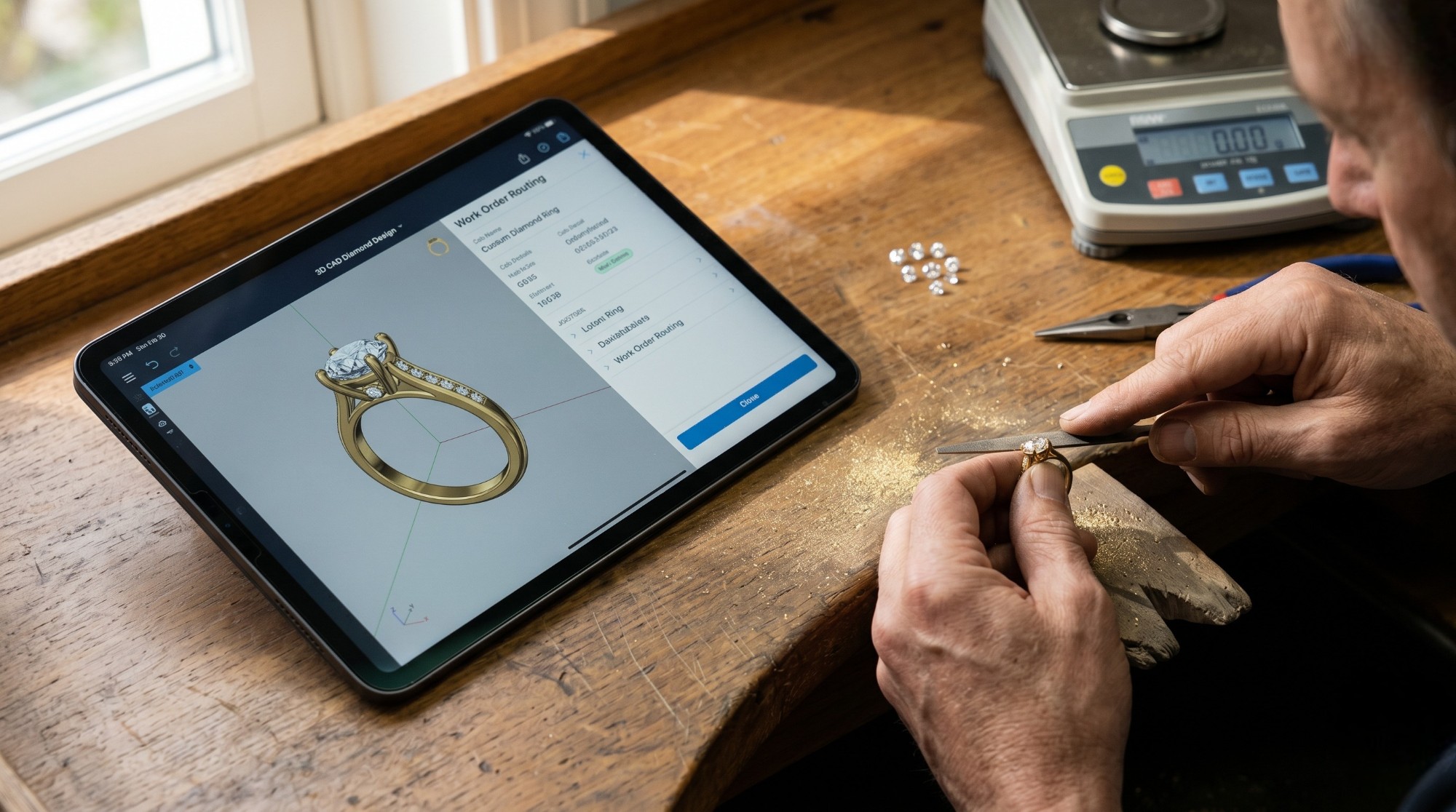
In recent years, the global and regional jewelry markets have witnessed a profound shift in consumer behavior. Modern buyers, particularly millennials and Gen Z, are no longer completely satisfied with mass-produced, ready-to-wear pieces displayed in retail windows. Instead, there is a surging demand for custom jewelry—unique, personalized creations that tell a story, commemorate a special occasion, or reflect the wearer’s exact aesthetic preferences.
For goldsmith workshops and jewelry manufacturers, this trend toward bespoke manufacturing represents a highly lucrative opportunity to command premium pricing and build lifelong customer loyalty. However, it also introduces a labyrinth of operational and administrative challenges. Unlike mass production, where costs and material requirements are standardized, every bespoke order is an entirely new project. Managing these unique projects requires surgical precision in tracking raw materials, dynamic pricing models, constant client communication, and strict financial control.
Attempting to manage this complexity using traditional methods—such as paper trails, disconnected spreadsheets, or generic accounting software—inevitably leads to material shrinkage, inaccurate pricing, and frustrated clients. This is where the implementation of a specialized Goldsmith Workshop Software becomes not just an operational upgrade, but a vital necessity for survival and growth. In this comprehensive guide, we will explore the lifecycle of bespoke orders, detailing how advanced technological solutions provided by Daysum transform chaotic workshop floors into highly efficient, digitally controlled manufacturing hubs.
The Challenge of Unique Pieces and Managing Custom Designs
The journey of a bespoke jewelry piece begins long before any metal is melted. It starts with an idea, a vision, or a rough sketch provided by the client. Translating this abstract concept into a tangible, high-value asset involves multiple stages of design, revision, and approval.
Centralizing Custom Designs and Client Specifications
In a traditional setup, design files, reference images, and client preferences are often scattered across WhatsApp messages, email threads, and physical notebooks. This fragmentation frequently leads to disastrous miscommunications—such as crafting a ring in 18k rose gold when the client specifically requested 21k yellow gold.
A sophisticated Goldsmith Workshop Software eliminates this risk by creating a centralized, digital “Project File” for every bespoke client. This unified dashboard houses all custom designs, including initial sketches and advanced 3D CAD (Computer-Aided Design) files used for 3D wax printing. The system mandates the entry of strict specifications, ensuring that every detail—from ring size in exact millimeters to the desired finish (matte, polished, or hammered)—is immutably recorded. By relying on a comprehensive Jewelry ERP software, the sales representative, the CAD designer, and the master goldsmith all look at a “single version of the truth,” entirely eradicating costly production errors.
Seamless Diamond Management and Stone Reservation
Bespoke orders frequently involve high-value center stones. A client might select a specific GIA-certified diamond from your inventory to be the centerpiece of their custom engagement ring. Here, Diamond management becomes critical.
In manual systems, a stone might be physically placed in an envelope, risking loss, or left in the digital inventory, risking being double-sold by another branch. An integrated software solution allows the sales team to digitally “reserve” or allocate that specific diamond (tracked by its unique certificate number) directly to the bespoke order. This instantly removes the stone from the available retail inventory, safeguarding it until it is officially handed over to the workshop for setting. If a client requests a rare gemstone not currently in stock, the system can immediately trigger an alert to the procurement department, utilizing the Odoo purchasing system to source the stone from international suppliers, tracking its shipment and landed cost seamlessly.
Linking Down Payments and Managing Financial Complexity
Because manufacturing custom jewelry requires a significant investment in raw materials (fine gold, diamonds) and highly skilled labor, goldsmiths never commence work without securing a financial commitment from the client. Handling this initial deposit correctly is a major accounting hurdle for many businesses.
The Accounting Reality of Down Payments
When a client pays a 50% deposit on a bespoke necklace, traditional or generic software often incorrectly records this as immediate sales revenue. From an accounting and compliance standpoint, this is a critical error. The product has not yet been delivered, and the final weight (and thus the final price) is still unknown.
A specialized Goldsmith Workshop Software manages down payments with absolute financial accuracy:
- Dynamic Quotation: Because the piece does not yet exist, the system generates a quotation based on the estimated gold weight, the live market price of gold, the specific cost of the reserved diamonds, and the estimated labor charges.
- Liability Recognition: When the customer pays the deposit, the system processes it using an integrated Odoo accounting system. The payment is recorded as a Customer Advance (a liability on the balance sheet) rather than recognized revenue.
- Order Linkage: This financial transaction is permanently linked to the unique bespoke order ID. This ensures that when the piece is finally completed months later, the system automatically retrieves the exact deposit amount to offset against the final invoice, preventing any manual calculation errors or disputes with the client.
Manual vs. Digital Management of Bespoke Jewelry Orders
| Operational Challenge | Traditional Manual / Fragmented Systems | Digital Management via Daysum Goldsmith Software |
| Design Tracking | Scattered across physical notes and messaging apps, leading to lost details. | Centralized digital files attaching 3D CAD models, client specs, and version histories. |
| Deposit Handling | Recorded as immediate revenue, causing tax discrepancies and final billing confusion. | Recorded correctly as a liability, automatically deducted from the final dynamic invoice. |
| Stone Allocation | Physical separation of stones; high risk of double-selling or loss. | Digital reservation of unique stones (by certificate) linked directly to the production order. |
| Client Updates | Reactive; clients must call the shop continuously to ask for production updates. | Proactive; automated SMS/Email triggers update the client as the piece moves through stages. |
Work Orders, Accurate Costing, and Controlling Metal Loss
Once the design is approved and the deposit is secured, the project moves from the showroom to the workshop floor. This is where raw materials are transformed into art, and where a company’s profit margins are most vulnerable to shrinkage, theft, and inefficiency.
Orchestrating Production with Work Orders
A bespoke piece does not magically appear; it goes through a strict routing process: casting, filing, assembling, stone setting, and final polishing. A robust software system generates specific work orders for each of these stages.
Through integrated Odoo manufacturing management, the workshop manager assigns a precise weight of raw gold to a specific artisan for a specific stage. The artisan becomes digitally accountable for that exact weight. This structured handover process eliminates the chaos of verbal instructions and undocumented material transfers, establishing a culture of accountability on the workshop floor.
The Battle Against Metal Loss (Scrap Management)
It is a physical reality of goldsmithing that you cannot craft a piece of jewelry without generating dust and scrap. Filing and polishing inevitably remove microscopic layers of precious metal. However, the critical management question is: where does acceptable natural loss end, and where does negligence or theft begin?
Advanced software tackles metal loss mathematically. The system allows management to set “Standard Scrap Allowances” for different types of work (e.g., 2% for polishing, 1.5% for casting). When an artisan returns a finished component, it is placed on a digital scale connected directly to the software. The system automatically:
- Calculates the difference between the gold issued and the gold returned.
- Compares this difference against the permitted scrap allowance.
- Automatically absorbs acceptable loss into the product’s cost structure.
- Triggers an immediate “Red Flag” management alert if the loss exceeds the permitted threshold, halting the closure of the work order until the discrepancy is investigated. Custom orders introduce their own loss points — see the specific controls that keep workshop shrinkage from eating into a bespoke piece’s margin.
Achieving Pinpoint Accurate Costing
The profitability of bespoke orders hinges entirely on costing. In manual workshops, the final price is often an educated guess that fails to account for hidden manufacturing costs. A digital system calculates the “Actual Cost” with surgical precision by aggregating:
- The exact cost of the fine gold consumed (factoring in the live gold rate).
- The monetary value of the acceptable metal loss.
- The precise procurement cost of the diamonds and gemstones used.
- The direct labor costs, calculated by tracking the exact hours artisans spent logged into their respective work orders.
This comprehensive data ensures that the final price quoted to the customer protects the workshop’s profit margins, preventing the business from unknowingly subsidizing complex custom jobs. Custom, made-to-order jewelry pieces need a workflow that tracks design approval, material issue, and labor cost as one linked job, not three separate records. Request a workshop-module demo to see a custom order tracked end to end.
Cost Breakdown Automation for a Bespoke Diamond Ring
| Cost Component | System Automation & Handling Mechanism | Impact on Profitability & Control |
| Precious Metal (Gold) | Pulls the exact consumed weight from the inventory at the live market rate. | Prevents underpricing against current market values; protects capital. |
| Scrap / Metal Loss | Calculates the financial value of unrecoverable gold dust during manufacturing. | Ensures the client absorbs the cost of natural manufacturing loss, preserving margins. |
| Diamonds / Stones | Retrieves the exact purchase cost of the specific reserved stone via its ID. | Prevents blending costs of differently priced stones; ensures accurate margin markup. |
| Labor & Overhead | Tracks total logged artisan hours multiplied by their specific wage rates. | Highlights operational inefficiencies; prevents labor-intensive pieces from destroying profits. |
Client Delivery, Final Settlement, and Compliance
After the bespoke piece passes rigorous Quality Control (QC) to ensure it perfectly matches the initial custom designs, the lifecycle reaches its final and most rewarding stage: delivering the masterpiece to the client and closing the financial loop.
Dynamic Final Settlement
Because custom jewelry is crafted by hand, the final weight of the finished piece rarely matches the initial “estimated” weight down to the milligram. A ring estimated at 10.00 grams might finish at 10.45 grams.
When the client arrives for pickup, the sales representative places the finished piece on the connected scale. The software instantly recalculates the final total price based on the actual gold weight and the final labor costs. The system then automatically retrieves the initial down payments made weeks earlier, deducts them from the new total, and presents the client with the exact remaining balance. This seamless, transparent process builds immense trust with the consumer.
E-Invoicing and Tax Compliance
In highly regulated markets like Saudi Arabia, finalizing a sale is inextricably linked to strict tax compliance (ZATCA Phase 2). The system must issue a legal, cryptographically stamped tax invoice.
Utilizing built-in e-invoicing support, the software instantly generates an XML invoice detailing the gold weight, the making charges, the diamond costs, and the correctly apportioned Value Added Tax (VAT). It generates the required Phase 2 QR code and communicates directly with the government’s tax portal in milliseconds. This guarantees that the workshop remains 100% compliant, shielding the business from severe financial penalties while providing the client with a professional, legally binding receipt of their bespoke investment.
Conclusion: Transforming Workshops into Smart Factories
Catering to the modern consumer’s desire for custom jewelry is an art form that requires immense creativity and metallurgical skill. However, running a bespoke jewelry service as a highly profitable, scalable business requires robust technology. Continuing to rely on outdated methods to manage custom orders guarantees margin erosion through untracked metal loss, inaccurate costing, and administrative chaos.
By adopting a comprehensive Goldsmith Workshop Software solution like Daysum, you are not merely buying an IT product; you are acquiring a digital nervous system for your business. From the moment a client sketches an idea, through the rigorous tracking of work orders and Diamond management, to the final legally compliant invoice, the software ensures absolute control. It empowers your artisans to focus on their craft, enables your sales team to deliver exceptional customer experiences, and provides management with the financial clarity needed to grow the brand with absolute confidence. Optimizing your precious metals inventory becomes seamless when you leverage Jewelry Workshop Repair ERP.
Frequently Asked Questions (FAQs)
The software provides a highly flexible financial and operational workflow for cancellations. Production managers can instantly halt active work orders to prevent further material consumption. Financially, the system allows the business to deduct an agreed-upon "design or cancellation fee" from the client's down payments. It then automatically processes a refund for the remaining balance and generates the appropriate tax-compliant Credit Note to reverse the accounting liabilities seamlessly.
Yes, this is a very common scenario in goldsmithing known as "Gold Exchange." The software features a dedicated module for this. It allows the intake of the client's old gold, automatically calculates its pure gold equivalent based on its karatage, and values it at the current market buying rate. This value is then securely logged as an "in-kind deposit," which is automatically deducted from the final cost of the newly crafted bespoke piece, ensuring completely transparent financial reconciliation.
Absolutely. The system enforces a strict "Bill of Materials" (BOM) protocol. The inventory manager cannot issue materials to the workshop floor that exceed the exact specifications dictated by the approved custom designs. If an artisan makes an error and requires additional raw material or a replacement diamond, the system mandates a digital "Manager Approval Workflow." This strict oversight ensures that no extra materials leave the vault without documented management authorization, heavily reducing internal theft and unrecorded waste.
Customer experience is heavily prioritized in the software's architecture. The system can be configured to trigger automated status updates via SMS or Email as the bespoke piece transitions through its manufacturing phases. For example, the client can receive an automated message saying, "Your 3D design has been approved and your piece is now in the casting phase." This proactive communication significantly elevates the luxury experience, builds anticipation, and frees your sales team from answering constant status inquiry calls.