Operating a high-value retail business in Saudi Arabia requires absolute precision in accounting and taxation. The Zakat, Tax and Customs Authority (ZATCA) has fundamentally changed how businesses document their sales, moving from basic paper receipts to cryptographic, real-time digital reporting. This transition is not merely a software update; it is a complete overhaul of the retail checkout process.
For the jewelry sector, this transition presents unique technical hurdles. Precious metals and gems are subject to complex pricing mechanisms involving daily market rates and artisanal labor costs. Standard retail software cannot process these variables while maintaining strict compliance with government mandates. Implementing a dedicated Jewelry ZATCA E-invoicing system powered by Daysum ensures that your operations remain fully legal, avoiding heavy fines while streamlining your daily financial reporting. This guide dissects the technical requirements of Phase 2, the exact mechanics of taxing precious metals, and how Daysum automates the entire compliance workflow.
What Are the ZATCA Phase 2 Rules?
The Saudi tax authority rolled out the e-invoicing initiative in two distinct phases. Phase 1 (Generation) simply required businesses to stop writing manual invoices and use an electronic system to generate a POS receipt featuring a basic QR code. Phase 2 (Integration), however, is significantly more complex and rigorous.
The Core Requirements of Integration
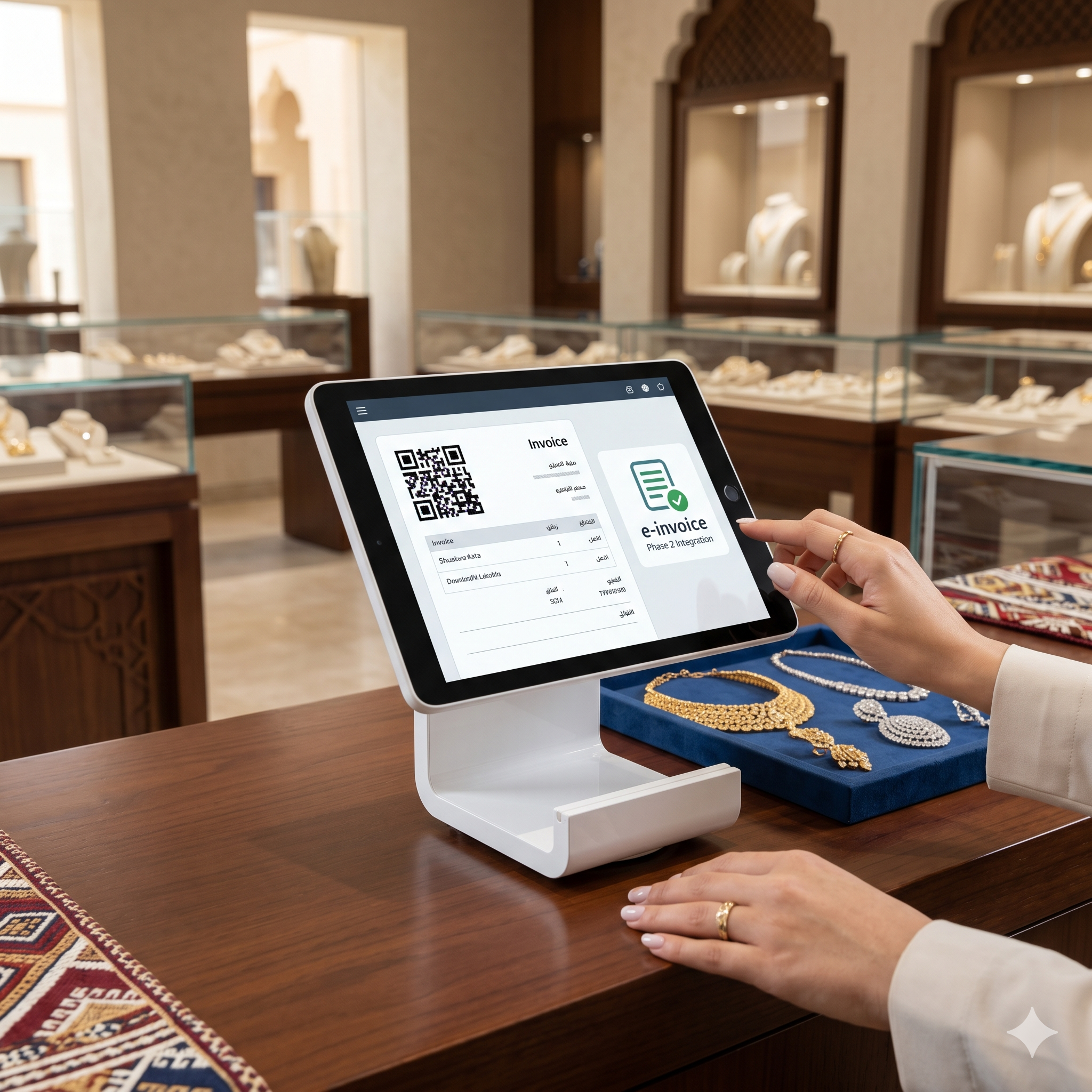
Under Phase 2, a jewelry store’s point-of-sale system must communicate directly with the Fatoora portal (the central ZATCA server). This integration enforces a strict set of cryptographic rules:
- Cryptographic Stamp: Every invoice must be digitally stamped using a private security key issued by the government. This proves the invoice originated from your specific, registered Daysum terminal.
- Previous Invoice Hash: To prevent the deletion or manipulation of past sales, each new invoice must contain a cryptographic “hash” (a unique text string) of the invoice that immediately preceded it. This creates an unbreakable chain of transactions.
- Real-Time Clearance: For B2B transactions (Tax Invoices), the system must send the XML data to ZATCA for clearance before you can hand the printed invoice to the buyer. ZATCA validates the data and returns it with an official QR code.
- Reporting of B2C Sales: For standard retail sales to end consumers (Simplified Tax Invoices), the system generates the invoice and QR code immediately for the customer, but it must report the transaction data to the ZATCA portal within 24 hours.
The Risks of Non-Compliance
Failing to comply with these rules—whether by using unapproved software, attempting to edit an invoice after issuance, or failing to report transactions within the time limit—results in severe consequences. The tax authority imposes escalating financial fines, and repeated violations can lead to the suspension of your commercial registration or the forced closure of your physical store.
Splitting Metal vs Labor: The VAT Calculation
The most critical challenge for tax compliance jewelry systems is the legal requirement to separate the cost of the raw material from the cost of the labor. When a customer buys a gold or silver piece, they are buying two distinct things combined into one item.
The Mechanics of the Split
Saudi tax law dictates specific rules for how VAT applies to precious metals versus how it applies to making charges. A standard POS system will apply a flat 15% VAT to the total final price. However, specialized jewelry accounting requires granular separation to protect margins and satisfy auditors.
- The Raw Metal Value: This is calculated based on the daily global spot price multiplied by the exact weight of the piece.
- The Making Charges (Labor): This is the fee charged by the craftsman or factory to design and assemble the item.
- Stone Valuation: If the piece contains diamonds or cubic zirconia, the value of those stones must also be accounted for.
A specialized Jewelry ZATCA E-invoicing system like Daysum automatically splits these components internally the moment the cashier scans the barcode.
Table: Anatomy of a Compliant Jewelry Invoice
|
Invoice Component |
Data Required by ZATCA |
How Daysum Handles It |
|
Seller Details |
Store Name, Address, VAT Number. |
Hardcoded into the system settings. |
|
Item Description |
Clear definition of goods (e.g., 18K Gold Ring). |
Pulled instantly from the database upon scanning. |
|
Weight & Rate |
Grams sold and the base metal price applied. |
Displayed clearly; rate is synced dynamically. |
|
Making Charges |
The specific labor fee applied to the item. |
Calculated automatically and split from the metal cost. |
|
VAT Calculation |
Exact 15% applied correctly to the taxable amounts. |
Auto-calculated with zero rounding errors. |
|
Cryptographic Data |
Hash, UUID, Cryptographic Stamp, Phase 2 QR. |
Generated in milliseconds via direct API link. |
When the POS receipt is printed, it satisfies both the customer’s need for transparency and the government’s need for exact tax data without requiring the cashier to perform any manual math.
Managing Return Policies Under ZATCA
In the retail sector, returns and exchanges are unavoidable. However, under ZATCA Phase 2, you cannot simply delete a previous invoice or hand cash back to a customer without proper documentation. Deleting a transaction breaks the cryptographic hash chain and immediately triggers an audit flag on the government portal.
The Credit and Debit Note Protocol
To handle return policies legally, your Daysum software must utilize electronic Credit Notes and Debit Notes.
- Credit Notes (Returns): If a customer returns a 10,000 SAR diamond necklace, the system must generate a ZATCA-compliant electronic Credit Note. This document must explicitly reference the original 36-character Unique Universal Identifier (UUID) of the initial sales invoice. The Credit Note reverses the VAT liability legally.
- Debit Notes (Upcharges): If an error occurred and the customer was undercharged, you must issue a Debit Note referencing the original invoice to collect the remaining balance and record the additional VAT.
Daysum automates this. When a cashier processes a return, they simply scan the original receipt. The system automatically pulls the original UUID, generates the correct XML Credit Note, signs it cryptographically, and reports it to the Fatoora portal within the mandated 24-hour window. This ensures your tax filing at the end of the quarter is perfectly balanced.
ERP Automation: Securing Your Operations with Daysum
Achieving ZATCA integration is not a task you can handle with a patchwork of disparate tools. It requires a unified ERP architecture where inventory, pricing, and tax reporting are tightly bound together.
Seamless Background Processing
The primary advantage of using Daysum for your tax compliance jewelry needs is invisibility. The cryptographic signing, XML generation, hash chaining, and API communication with ZATCA happen entirely in the background.
Your cashiers do not need to understand cryptography. They simply scan the jewelry, take the payment, and press print. Daysum’s server handles the heavy technical lifting, ensuring that the transaction is processed in under a second. This speed is vital during peak holiday seasons when long checkout lines can damage customer satisfaction.
Bulletproof Tax Filing
At the end of the financial quarter, preparing a VAT return is historically a stressful process involving cross-referencing hundreds of receipts. Daysum eliminates this friction. Because every transaction (Sales, Credit Notes, Debit Notes) has already been validated and accepted by ZATCA’s servers in real-time, your digital ledger matches the government’s ledger exactly.
The system generates a comprehensive, one-click tax report summarizing your total taxable sales, total VAT collected, and total VAT refunded. Your accounting team simply transfers these exact, verified numbers to the tax portal, securing your business against audits and penalties. If you want to facilitate better supply chain management and data analytics, check out The Role Of Financial Reports In Improving Store Performance.
Frequently Asked Questions (FAQ)
ZATCA regulations account for temporary offline scenarios. The Daysum system will continue to generate Phase 2 compliant invoices locally, assigning the correct cryptographic hashes and UUIDs. Once your internet connection is restored, the software will automatically upload the backlog of transactions to the Fatoora portal, ensuring you meet the 24-hour reporting deadline.
Daysum is a cloud-based software solution. You do not need to purchase separate, proprietary government hardware devices. As long as your existing computers or tablets have an internet connection and run a modern browser, Daysum securely handles the integration via its servers.
Yes. When an authorized manager applies a discount at the checkout, Daysum recalculates the subtotal before applying the 15% VAT. The final generated invoice will clearly show the original price, the discount amount applied, the new taxable subtotal, and the precise VAT amount, keeping you fully compliant.
For B2B transactions, ZATCA requires a "Standard Tax Invoice." Daysum pauses the printing of the receipt, instantly sends the XML data to the ZATCA clearance portal, receives the cryptographic approval and official QR code back in milliseconds, and then prints the fully cleared invoice to hand to the business buyer.
Daysum archives every transaction permanently. The cashier simply searches the customer's phone number or the specific item SKU in the return module. The system immediately retrieves the historical transaction, pulling the exact cryptographic UUID required to generate the legal Credit Note.
Absolutely. Daysum utilizes enterprise-grade TLS encryption for all data transmitted between your store, our cloud servers, and the ZATCA API. The government only receives the specific tax data required by law; your internal cost data and supplier information remain strictly confidential within your private ERP.