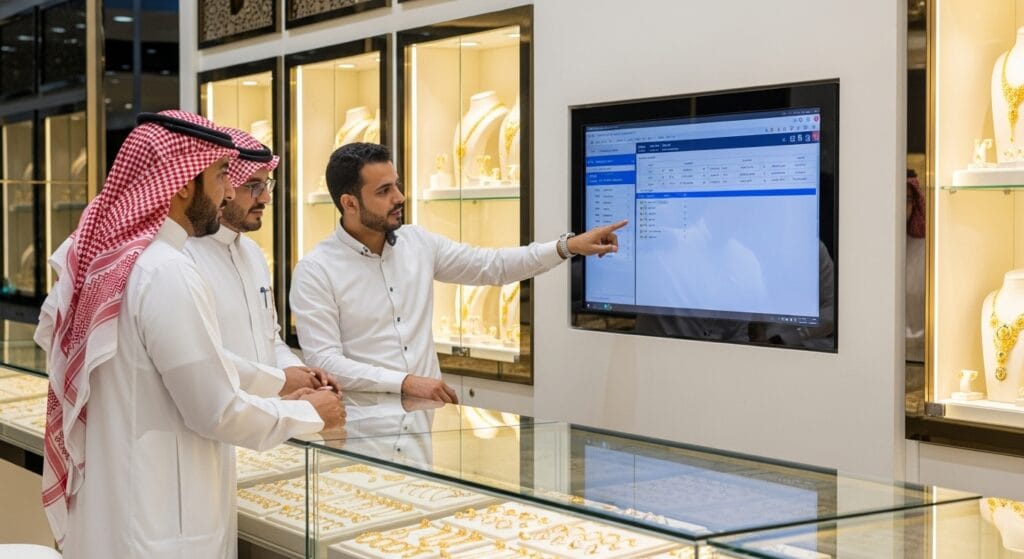
Opening a jewelry online store in Saudi Arabia has become a practical step for gold and jewelry shops, but a jewelry store differs from other online stores in three ways: the price moves with the gram rate every day, every piece has its own weight, karat and size, and each parcel is high in value and needs insurance and careful packaging.
Launching a jewelry store on Salla means solving these points before the first product goes live: how prices update daily, how karat and size options are shown, who carries the shipping risk, and how the tax invoice is issued at the correct value. Before all of that, you need to confirm the Sharia and regulatory rules for selling gold at a distance.
This guide walks through those steps in order, with examples in Saudi riyals, and explains how Daysum’s gold system links the store to your stock and accounts.
Why Gold Shops are Moving Online
Gold shops are moving online because customers start their search on the internet before visiting a shop, and an online store keeps the collection available at any time and from any city. A store also lets you show weight, karat and price clearly in a way social media alone rarely does.
Salla offers jewelry sellers marketing tools, several payment methods and links to shipping companies, along with apps in its app store that update gold and silver prices from global rates. That keeps the cost of starting lower than opening a new branch.
Selling online, however, exposes any weakness in stock and pricing control. A piece sold in the showroom in the morning may still be listed online, and a price that was not updated may sell a piece at a loss. A successful launch therefore starts with the system that runs stock and prices, not with the store design.
Sharia and Regulatory Rules for Selling Gold Online
Before launch, check two things: the Sharia ruling on the sales model your store uses, and the regulatory requirements for trading in precious metals. This article does not issue a ruling; it points you to the competent bodies.
The Sharia Ruling on Selling Gold at a Distance
Saudi Arabia’s Permanent Committee for Scholarly Research and Ifta has been reported as stating that immediate exchange of possession (taqabud) is a condition for buying and selling gold, including online, and that the transaction is not permissible without it. Scholars differ on which forms of constructive possession, payment and delivery satisfy that condition. Merchants should therefore put their store’s sales model to an official fatwa body, such as the General Presidency of Scholarly Research and Ifta, before launch.
Regulatory Requirements for Precious Metals Trading
Trading in precious metals and gemstones requires a licence for the activity, and the Precious Metals and Gemstones Law sets out information that must be disclosed at the point of sale, including detailed data for gemstones set in precious metals. Because these rules attach to the activity rather than the channel, they apply to an online store just as they do to a shop. For licences and hallmarking, see our guide on how to open a gold shop in Saudi Arabia; the Ministry of Commerce is the final reference.
Daily Jewelry Pricing from the Gram Rate and Workmanship
The price of a jewelry piece equals its weight in grams multiplied by that day’s gram rate for its karat, plus workmanship, with VAT added on top. Because the gram rate changes every day, a piece’s price cannot be fixed in the store.
The example below is illustrative and uses an assumed gram rate, not a market price: a 21-karat ring weighing 5 grams, at an assumed SAR 380 per gram, with workmanship of SAR 40 per gram.
| Item | Calculation | Amount |
|---|---|---|
| Gold value | 5 g × SAR 380 | SAR 1,900 |
| Workmanship | 5 g × SAR 40 | SAR 200 |
| Total before VAT | 1,900 + 200 | SAR 2,100 |
| VAT at 15% | 2,100 × 15% | SAR 315 |
| Price shown to the customer | VAT-inclusive | SAR 2,415 |
If the gram rate rises to SAR 390 the next day, the inclusive price becomes SAR 2,472.50. With hundreds of pieces in different weights and karats, manual updates become a constant source of errors. Pricing is therefore automated: each piece’s weight, karat and workmanship are stored in the system, the gram rate is updated once, and every price follows. Our guide to live metal pricing explains how this works.
Karat and Size Options on Salla
Salla lets you add product options such as size or metal type, with a different price and quantity for each option. That suits jewelry, because changing the size or karat changes the weight and therefore the price.
When to Use Options and When to Split Products
If options differ only in size, such as one ring design in several sizes, options work well as long as each size has its own weight and price. If they differ in karat, such as a design offered in 18 and 21 karat, it is usually better to give each karat its own product or an option with a fully separate price, because the gram rate is different.
What to Show on the Product Page
Show the karat, weight in grams and workmanship on every product page, plus stone details where relevant, and any certificate or warranty along with who issued it. This builds customer trust and reduces returns caused by mismatched expectations.
Also read: Salla product options linked to price, stock and SKU in your ERP, to see how options are set up on the system side.
If you are planning to launch a jewelry store and want to see how prices and options would be run from your system, talk to the Daysum team to review your collection before launch.
Insured Shipping and Packaging
A high-value parcel needs a courier that accepts valuables and insures them, plus packaging that does not reveal what is inside. Salla notes that some of the shipping apps available on the platform support shipping valuable products with insurance.
Before promising customers any cover, check the courier’s insurance limits, liability for the parcel and claim terms, as these vary between providers. State your shipping and exchange policy clearly in the store: who carries the risk until delivery, and what the customer must do on receipt.
In practice, use neutral outer packaging, record the parcel’s weight and photos before handover, and ask for the recipient’s identity to be checked on delivery. Record the shipment in the system so that stock in transit is shown separately from available stock.
Tax Invoices for Jewelry: Gold Value and Workmanship
Gold jewelry is subject to VAT at 15% when sold by a VAT-registered person, while gold of 99% purity or higher that is tradable on the international bullion market is zero-rated, according to statements from the Zakat, Tax and Customs Authority (ZATCA). ZATCA has also stated that VAT is charged on the full value of the gold on the invoice, including workmanship fees.
It is good practice for the invoice to show gold value and workmanship as separate lines so the customer can see how the price is built, with VAT applied according to ZATCA’s treatment. The e-invoice for each order is issued from a solution integrated with the Fatoora platform. For special cases, such as exchanging used gold for new pieces or buying gold from individuals, confirm the VAT treatment with ZATCA or your tax adviser before using it in the store.
Connecting the Store to Daysum’s Gold System
Daysum’s gold and jewelry ERP manages stock by weight and karat, works from the daily gold price, connects to Salla stores through Daysum’s Salla integration app, and issues ZATCA-approved e-invoices. The online store then becomes a sales front for a single stock you run from one system.
| Task | Without Integration | With a Gold System Linked to Salla |
|---|---|---|
| Price updates | Manual, per product, every day | Gram rate updated once |
| Stock | Separate figures for store and showroom | One balance by weight and karat |
| Tax invoice | Prepared in the store, then copied to accounts | Issued from the system and sent to Fatoora |
| Journal entry | Keyed in at period end | Posted with every order |
Conclusion: An Online Jewelry Store with Correct Prices Every Day
Launching a jewelry store on Salla starts with checking the Sharia ruling on your sales model and the regulatory requirements, then building prices on weight, karat, gram rate and workmanship, setting up options and insured shipping, and issuing a correct tax invoice at full value.
When all of this runs from a gold system connected to the store, prices update daily without manual work and stock stays as one figure across showroom and store.
If you are preparing to launch your store, or want to connect an existing Salla store to a gold system, contact the Daysum team to discuss the setup steps.
FAQs About Selling Gold Online
This is a Sharia question for official fatwa bodies. Saudi Arabia's Permanent Committee for Scholarly Research and Ifta has been reported as stating that immediate exchange of possession is a condition for selling gold, including online, and scholars differ on which forms of possession satisfy it. Put your store's sales model to the General Presidency of Scholarly Research and Ifta before launch.
Each piece's weight, karat and workmanship are stored in the system, and the gram rate for each karat is updated once a day. The system then recalculates piece prices and sends them to the store. Salla's app store has apps that update prices from global rates, and updates can also come from a gold system linked to the store.
No. According to ZATCA's statements, gold jewelry sold by a VAT-registered person is subject to 15% VAT, charged on the full value of the gold on the invoice including workmanship. Gold of 99% purity or higher that is tradable on the international bullion market is zero-rated. For special cases such as exchanges, check with ZATCA or your tax adviser.
You can, provided each option has its own price calculated from its weight and its karat's gram rate, since Salla allows a different price and quantity per option. Many merchants, however, prefer a separate product for each karat to keep pricing and reporting simple, and use options for sizes only.
Choose a courier that accepts valuables and insures them, and check the cover limits and claim terms before launch. Use neutral packaging, document the parcel before handover, and ask for the recipient's identity to be checked on delivery.