Navigating the rapid digital transformation of the Saudi economy in 2026 can feel like walking through a regulatory minefield. The Ministry of Finance and the Saudi Tax Authority (ETA) have completely overhauled how businesses report their revenue, permanently closing the chapter on paper ledgers. Today, absolute compliance with Saudi taxes relies on your company’s ability to transmit flawless digital data directly to government servers.
However, as business owners scramble to upgrade their software architecture, a massive point of confusion continues to paralyze decision-makers: What is the actual difference between E-invoicing and the E-receipt system? Do you need one, the other, or both?
Choosing the wrong digital framework will not only disrupt your daily operations but also expose your enterprise to severe financial penalties and the suspension of your commercial activities. In this comprehensive guide, we will demystify the ETA’s mandates, clearly separate the requirements for B2B sales and B2C sales, and help you identify exactly which technological infrastructure your company must deploy to remain legally compliant and highly profitable.
1. The E-Invoice: The Backbone of B2B Sales
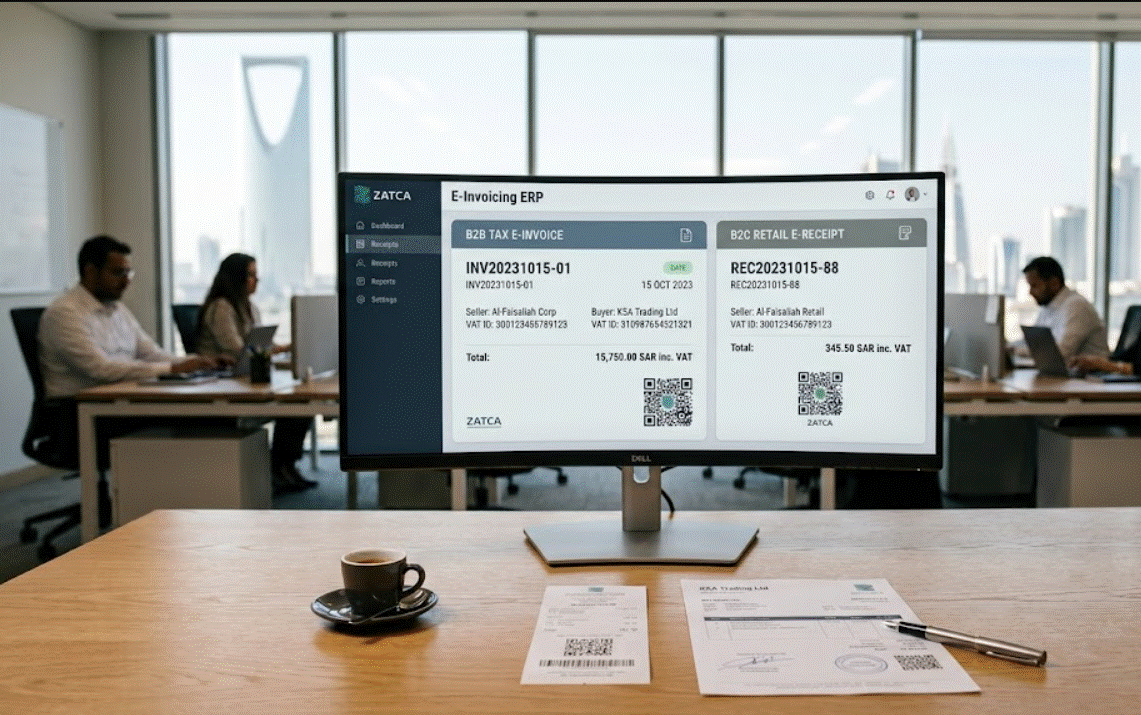
The Electronic Invoice (E-Invoice) system was the first major digital mandate rolled out by the ETA, and it is designed specifically to monitor transactions between registered businesses.
Pre-Clearance and the E-Signature
If your company supplies raw materials to a factory, acts as a wholesale distributor, or provides corporate consulting, you are executing B2B sales. In KSA, an E-Invoice operates on a strict “Pre-Clearance” model. This means that when you generate an invoice in your accounting software, it is not legally valid to send to your corporate client immediately.
First, the digital document (formatted as JSON or XML) must be cryptographically signed using a mandatory E-signature (via a secure USB token or a Hardware Security Module). This payload is then transmitted to the ETA’s Tax portal. The government servers validate the signature, check the standardized product codes (GS1 or EGS), and return a Unique Universal Identifier (UUID). Only after this UUID is attached can the invoice be legally forwarded to the buyer, allowing them to claim their VAT deductions.
2. The E-Receipt System: The Frontline of B2C Sales
While the E-Invoice tracks corporate money flows, the E-receipt system was launched to capture the massive volume of retail transactions occurring directly with final consumers.
Speed and POS Integration
If you operate a grocery store, a retail clothing boutique, a pharmacy, or a restaurant, your transactions are classified as B2C sales. Consumers do not have Tax Identification Numbers (TINs), nor do they care about claiming business VAT deductions. They want to pay for their goods and leave quickly.
Because of this need for speed, the E-receipt system operates differently. It is deeply integrated directly into your POS (Point of Sale) hardware or software. When a cashier finalizes a sale, the system instantly prints a physical receipt (or emails a digital one) containing a dynamic ETA-verifiable QR code. The transaction data is then transmitted to the ETA’s servers. Unlike the B2B system, B2C receipts operate on a post-clearance or near real-time model, ensuring that the checkout line never slows down while waiting for a government server response.
Core Differences Between E-Invoice and E-Receipt
| Feature | E-Invoicing (Fatoora) | E-Receipt System |
|---|---|---|
| Primary Target | B2B sales (Business to Business) & B2G. | B2C sales (Business to Consumer). |
| ETA Validation Model | Pre-Clearance (Validated before giving to buyer). | Post-Clearance (Transmitted during or shortly after the sale). |
| Buyer Identification | Mandatory Tax Identification Number (TIN) and address. | Anonymous (unless transaction exceeds a specific high-value threshold). |
| Cryptographic Security | Requires physical E-signature (USB token / HSM). | Uses a digital POS certificate registered with the ETA. |
3. Determining Exactly What Your Company Needs
The technological infrastructure you must invest in depends entirely on your business model. Let us break down the three primary operational scenarios in the Saudi market.
Scenario A: Pure B2B Operations
If you are a corporate law firm, a heavy machinery manufacturer, or a B2B marketing agency, you never sell to individual consumers.
- What you need: You strictly need an E-invoicing integration. You must acquire an E-signature token from a certified provider (like KSA Trust) and ensure your accounting ERP software is capable of mapping your services to ETA codes and transmitting XML payloads to the Tax portal.
Scenario B: Pure Retail and B2C Operations
If you run a local coffee shop or a chain of consumer electronics stores, your clients are everyday citizens.
- What you need: You strictly need the E-receipt system. You must register your POS devices with the ETA to obtain the necessary digital certificates. Your priority is investing in a lightning-fast point of sale system that generates QR codes instantly without causing checkout delays.
Scenario C: The Hybrid Model
This is the most common and complex scenario. Suppose you operate a wholesale electronics business that supplies local businesses (B2B sales) but also has a storefront open to the general public (B2C sales).
- What you need: You need both. In the eyes of Saudi taxes, you must report your corporate sales through the E-Invoice portal and your consumer sales through the E-Receipt portal. Attempting to manage this with two different software programs will cause an administrative nightmare. You must invest in a unified, omni-channel ERP ecosystem that automatically routes the transaction to the correct ETA portal based on whether a customer TIN is present.
Table 2: Technical & Hardware Requirements Comparison
| Requirement Category | E-Invoice Requirements | E-Receipt Requirements |
|---|---|---|
| Hardware | USB E-Seal Token or HSM server. | Smart POS terminal or integrated PC-based cash register. |
| Software Integration | ERP API connection to the main ETA Tax portal. | API connection to the ETA’s core B2C receipt receipt engine. |
| Internet Dependency | High. Transactions cannot be finalized without a UUID. | Moderate. POS can often queue receipts locally if offline temporarily. |
| Document Formatting | JSON or XML payloads strictly formatted to ETA schemas. | JSON payloads containing specific POS serial numbers and QR data. |
4. Unifying Your Tax Strategy for Absolute Compliance
The Saudi government’s aggressive push toward a digitized economy is not a temporary trend; it is the permanent reality of doing business in 2026. Treating E-invoicing and the E-receipt system as mere IT annoyances exposes your enterprise to massive audits, hefty fines, and the potential loss of vital VAT deductions.
The most successful companies in KSA have stopped viewing compliance as a burden and started utilizing it as a catalyst for operational efficiency. By implementing a modern, cloud-based ERP, you eliminate manual data entry entirely. When your sales team closes a corporate deal, the system handles the E-signature and ETA submission silently in the background. When your retail cashier scans an item, the POS prints a compliant receipt instantly.
Do not let regulatory confusion stall your growth. Assess your sales channels, identify whether you operate in the B2B or B2C space, and partner with a technology provider that deeply understands Saudi taxes to secure your digital infrastructure today.
Frequently Asked Questions (FAQs)
Technically, the ETA previously allowed businesses to issue E-Invoices to consumers by using the generic national ID code for B2C transactions. However, as the E-receipt system has fully matured and become mandatory for retail sectors, the ETA strictly requires B2C transactions to be routed through the dedicated E-Receipt portal using certified POS environments. Using the B2B portal for retail sales is no longer a compliant long-term strategy.
No, you do not need a physical USB token plugged into your cash register. The E-receipt system relies on a software-based digital certificate that is issued by the ETA and securely installed directly onto your certified POS machine or ERP system. This allows for rapid, automated signing of retail receipts without the need for physical hardware tokens at every checkout lane.
The ETA understands that retail environments experience internet outages. Certified E-Receipt POS systems are designed with a secure offline mode. If the connection drops, the cashier can continue to process B2C sales and print receipts with the required QR codes. The system securely queues the transaction data locally. Once the internet connection is restored, the system will automatically upload the batched receipts to the Tax portal within the legally permitted timeframe.
No, the product coding structure is unified. Whether you are selling 100 laptops to a corporation via an E-Invoice or 1 laptop to a student via an E-Receipt, the ETA requires you to use the exact same standardized product codes (either global GS1 codes or internally mapped Saudi Goods and Services - EGS codes). These codes must be approved by the ETA prior to use on either platform.